

There is a principle in data and systems work that applies directly to commission automation: garbage in, garbage out. A bad commission plan does not get corrected by automation. It gets executed consistently and at scale, every pay period. It will execute it, consistently and at scale, every pay period.
The risk is not that automation fails. It is that it works exactly as configured. A bad commission plan that produces payout disputes, misaligned incentives, and recruiter confusion once a month in a spreadsheet will produce the same outcomes in an automated system.
The difference between a bad commission plan that runs in a spreadsheet and one that runs in an automated system is not the logic. It is the scale and speed at which that logic compounds.
Why Automating First Is the More Expensive Mistake
A bad commission plan that produces disputes and misaligned incentives in a spreadsheet will produce the same outcomes in an automated system, just more efficiently.does not evaluate the logic it executes.
A Plan That Drives the Wrong Behaviors Will Drive Them More Efficiently After Automation
A bad commission plan shapes recruiter behavior whether it is running in a spreadsheet or an automated system, because commission design determines where recruiters focus their time, which roles they prioritize, and how aggressively they close. When that design contains flawed incentive alignment, automation does not neutralize the problem, it operationalizes it.
A bad commission plan does not become a good one when you remove the spreadsheet. It becomes a faster, more consistent version of the same problem.
Read More: Commissions Accuracy Starts with Clean Data (Not Better Software)
Disputes That Happen Monthly in Spreadsheets Will Happen Monthly in Your Automated System Too
A commission dispute is rarely just a calculation error. A bad commission plan produces disputes not because the calculations are wrong but because the underlying rules are ambiguous, inconsistently applied, or interpreted differently by the people on each side of the payout. More often it is a signal that the underlying rules are ambiguous, inconsistently applied, or interpreted differently by finance and the recruiter receiving the payout.
Automating that ambiguity does not resolve it, it just moves the argument from a spreadsheet to a support ticket. The dispute cadence stays the same because the source of the dispute was never the calculation method to begin with.
The Cost of Unwinding a Misconfigured Commission Engine Is Higher Than Fixing the Plan First
Once a bad commission plan has been configured into an automated system, every correction requires reopening the logic, reprocessing historical payouts, and resetting expectations across a team that has already adjusted to the existing setup. When finance and recruiters cannot reach a shared interpretation of the same rules, the firm is operating with a bad commission plan whether it has been automated or not.
That process is disruptive in ways that a pre-automation plan review is not, and it compounds with every pay period the misconfigured system runs before the problem is caught.
Signs Your Commission Plan Is Not Ready to Automate
A bad commission plan leaves structural signals before it ever touches an automation system. These are the ones often overlooked.
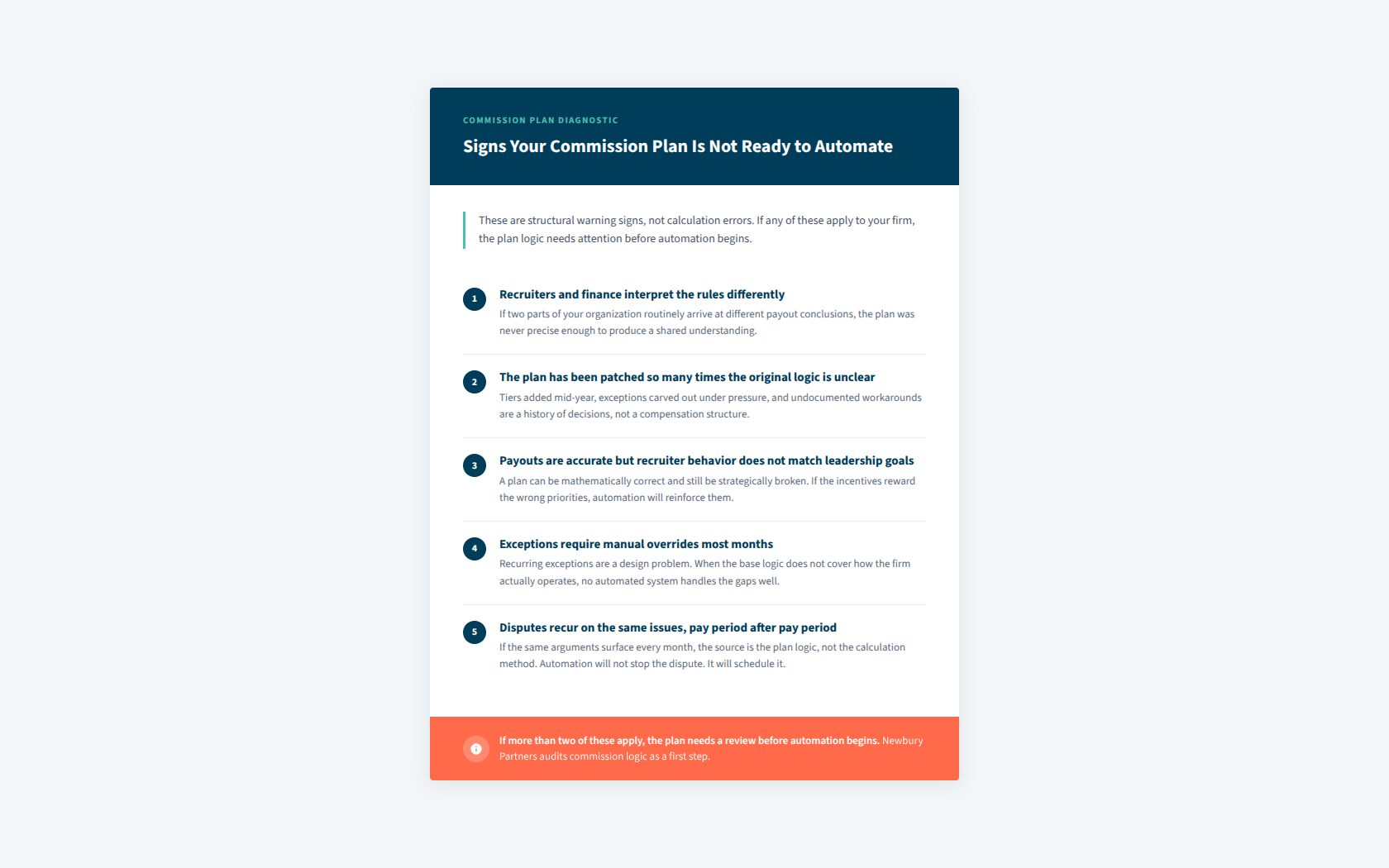
Recruiters and Finance Rarely Agree on What the Rules Actually Say
When two parts of the same organization interpret the same commission plan differently, the plan itself is the problem. That disconnect surfaces not because people are being difficult, but because the rules were never precise enough to produce a shared understanding.
A WorldatWork survey found that fewer than half of organizations provide full transparency into how their incentive plan metrics work at the start of the year, and only 17% explain how individuals can actually influence their results.1 If that gap exists in your firm, it needs to be resolved in the plan before it gets encoded into a system.
Your Plan Has Been Patched So Many Times Nobody Remembers the Original Logic
Commission plans in staffing firms rarely get rebuilt from scratch. They get adjusted, with a new tier added here, an exception carved out there, and a workaround introduced mid-year that nobody formally documented.
Over time those layers accumulate until the plan is no longer a coherent set of rules but a history of decisions made under pressure. When that accumulated history is what gets handed to an automation project, a bad commission plan does not get cleaned up in the build. It gets encoded into it.
The Plan Pays Out Correctly But Is Not Driving the Behaviors Leadership Actually Wants
A bad commission plan is not always one that calculates incorrectly. Sometimes it is one that pays out exactly as configured while systematically rewarding the wrong priorities. If your plan is paying out as configured but your recruiters are consistently prioritizing the wrong role types, deprioritizing hard-to-fill positions, or optimizing for short-term placements over long-term account development, the incentive alignment between the plan and leadership’s actual goals has broken down.
A mathematically accurate bad commission plan is still a bad commission plan, and automating it will reinforce the misalignment rather than resolve it.t the behavior. It will reinforce it.
Exceptions Have Become the Rule
When a significant portion of monthly payouts require a manual override or a leadership decision outside the standard plan, that is not an administration problem. It is a bad commission plan problem.
Exceptions that recur with regularity are usually a sign that the base plan logic does not adequately cover how the firm actually operates, and no automation system handles informal exceptions well.
Commission Automation Works Best When the Logic Is Already Sound
A bad commission plan that gets automated does not become a good one. It becomes a misconfigured system that compounds the original design problem with every pay period it runs. Newbury Partners works with staffing firms to validate commission logic before automation begins. The Discovery process documents your actual rules, exceptions, and edge cases so that what gets built reflects how your firm actually pays, not how a spreadsheet approximated it.
If your commission plan has grown through patches, exceptions, and workarounds, that is a reasonable place to start the conversation. Contact us before your next automation project begins.
Reference
1. Podstupka, Sharon. “Short-Term Incentives Not Driving Performance? There’s a Solution.” Workspan Daily, WorldatWork, 22 Oct. 2025, worldatwork.org/publications/workspan-daily/how-better-communication-can-turn-sti-plans-into-performance-drivers.