

Have you checked the spreadsheet, reviewed the data, and still ended up back in the same conversation the following month? When commission errors persist after changes have already been made, you may be experiencing broken commission rules. This means the rules driving your calculations may be the part that has gone unexamined.
Most firms revisit their process before they revisit their logic, but outdated payout rates, misaligned triggers, and split percentages that were never corrected in the system do not fix themselves when you clean up the workflow around them. Here is what broken commission rules look like and what they cost when left uncorrected.
What Broken Commission Rules Look Like
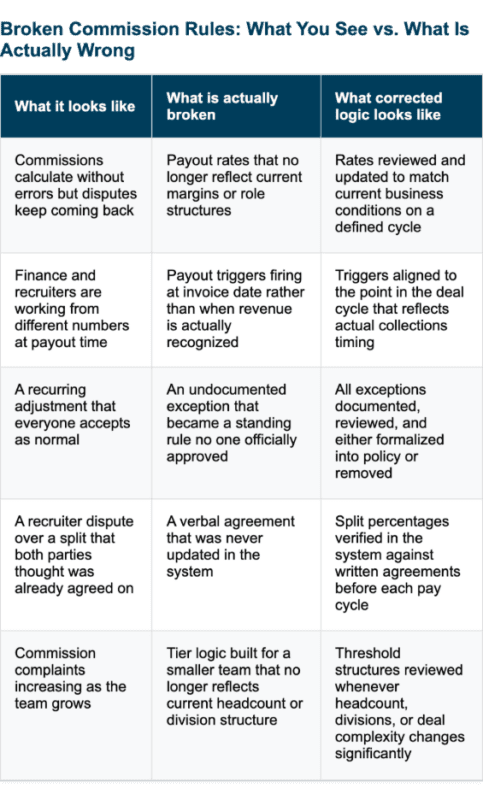
Commission rules break in predictable ways. Most firms are living with at least one of these without realizing it because the system keeps running, just not correctly.
Read More: From Spreadsheets to Smart Systems: How Staffing Firms Can Modernize Without Disrupting Operations
Outdated Payout Rates
Commission percentages set two or three years ago may no longer reflect your current margins, role structures, or market positioning. The calculation runs without errors because the formula is technically correct. The problem is that it is faithfully executing a rate that no longer applies to how your business operates today.
Misaligned Payout Triggers
If commissions fire at invoice date, but collections happen 60 to 90 days later, your payouts and your revenue recognition are running on different timelines. This creates cash flow gaps that compound across a full recruiter team and makes financial forecasting harder than it needs to be.
Exception Creep
A one-time manual override for a single recruiter feels reasonable in the moment. A top performer closes an unusual deal, the structure does not fit the standard rule, and finance makes an adjustment. That exception tends to stick. The next time a similar situation comes up, someone remembers the override happened before and applies it again.
Over time, what started as a single accommodation becomes an undocumented standing rule applied inconsistently across the team. No one makes a deliberate decision to change the commission structure. It just drifts. By the time someone audits the logic, the exceptions may outnumber the original rules, and reconstructing the policy requires tracking down emails and conversations from years ago.
Split Attribution Drift
Verbally agreed split percentages that were never updated in the system create a gap between what recruiters expect and what the calculation produces. That gap is rarely caught immediately because both parties assume the system reflects the agreement. The recruiter sees their payout, does a rough mental calculation, and the number is close enough not to raise a flag.
It is only when a larger deal closes or a recruiter starts tracking their earnings more carefully that the discrepancy becomes visible. By then, the system may have been running the wrong split for months. The dispute that follows is not about the split percentage. It is about the fact that an agreement was made, assumed to be in place, and silently miscalculated for longer than anyone realized.
Threshold Logic That Has Not Scaled
Commission tiers designed for a smaller, simpler team applied unchanged to a multi-division firm create situations where the logic rewards the wrong behavior at the wrong level. What worked at 20 recruiters often breaks down at 70, not visibly, but gradually, in ways that surface as recruiter dissatisfaction rather than system errors.
What Broken Commission Rules Cost When Left Uncorrected
Broken commission rules do not stay contained. They surface at payout time, affect recruiter behavior between payouts, and create compounding costs that go well beyond the disputed amount.
Recruiter Trust and Motivation Erode Before Anyone Says Anything
Recruiters rarely escalate a commission concern the first time they notice something feels off. They absorb it, mention it to a colleague, and start making quiet adjustments to how hard they push on certain deal types. Sales teams operating under annually reviewed compensation plans are 15% more likely to meet their strategic goals.1
Plans running on stale or inconsistent logic work against that outcome by rewarding the wrong behaviors or miscrediting contributions before a dispute ever gets filed.
Finance Absorbs Costs That Belong Upstream
When payout calculations are wrong, finance investigates, reconciles, and corrects. That is the same resource drain as disputes, but the source is in the logic rather than in the process. Cleaning up a downstream error every month is a different problem than fixing the rule that keeps generating it, and the two are often treated as the same issue until someone maps where the error actually originates.
Broken Logic Becomes Harder to Fix as Complexity Grows
Commission rules that are manageable at current scale become operational blockers as headcount and deal complexity increase. Organizations are increasingly recognizing that compensation structures require more frequent attention than most firms give them, with the share of employers conducting two or more salary review cycles annually more than tripling between 2017 and 2021.2
If you do not audit your commission logic before scaling, you carry the error forward into every new hire, new division, and new client tier you add.
Not Sure If Your Commission Rules Are Still Working?
A broken commission rule is hard to spot from inside the system because the calculations keep running, just not correctly. Newbury Partners works with staffing firms to identify where commission rules have drifted, stalled, or never reflected the actual agreement in the first place.
If disputes keep coming back after other fixes have already been made, the logic is worth a closer look. Start with a commission logic assessment.
References
1. Jain, Amit. “10 Myths and Facts About Sales Compensation.” LinkedIn, 22 Nov. 2024, www.linkedin.com/pulse/10-myths-facts-sales-compensation-amit-jain-okfqf/.
2. McKinsey, Rebecca. “Geared for Success: The Benefits of More Frequent Compensation Cycles.” Workspan Daily, 19 Mar. 2025, worldatwork.org/publications/workspan-daily/geared-for-success-the-benefits-of-more-frequent-compensation-cycles.