

Your firm has invested in an ATS, VMS, and other core platforms designed to streamline operations. Yet when you look at how work gets done, how many of these scenarios feel familiar? These patterns suggest your firm needs staffing technology modernization that aligns with actual workflows.
- Your top recruiter maintains a personal Excel tracker for their pipeline.
- Someone built a Google Sheet for client follow-ups because pulling that information from your CRM takes too many clicks.
- Critical placement data lives across multiple systems that don’t talk to each other, requiring manual updates to keep everything current.
These workarounds aren’t signs of poor training or resistance to technology. They’re signals that your systems don’t align with how recruiting work flows. The question isn’t whether you have the right tools, but whether those tools support the way your team operates or create friction that makes manual processes feel more efficient.
The Enterprise Tool Paradox: Why Teams Build Workarounds Around Expensive Systems
Here’s why manual processes persist despite significant technology investment:
- Your ATS doesn’t display the specific view recruiters need – Standard dashboards show system-designed metrics, not the combination of candidate status, last contact date, and client urgency that drives daily prioritization decisions.
- “Efficient” features require inefficient navigation – Accomplishing a routine task takes six clicks through three different screens when a spreadsheet formula does it in seconds.
- System data doesn’t reflect current reality – Sync delays, missing fields, or incomplete integrations mean recruiters can’t trust official reports for time-sensitive decisions.
- The prescribed workflow doesn’t match how deals actually close – Your system enforces a linear process, but successful placements often require jumping between stages or managing multiple parallel tracks.
- Training focused on features rather than solving problems – Team members learned where buttons are located, not how the system accomplishes what they actually need to do each day.
These workarounds aren’t symptoms of resistance to change. Research shows that 64 percent of business users believe they understand their department’s technology needs better than central IT, and 57 percent have implemented at least one technology solution without IT involvement.1
The gap between system capabilities and operational requirements creates conditions where manual processes feel more reliable than the official tools designed to replace them.
Read More: Before the Switch: How Staffing Firms Can Prepare Their Data for a Smooth CRM Migration
Is Your Tech Stack Creating Operational Debt?
Check all that applies to your operation:
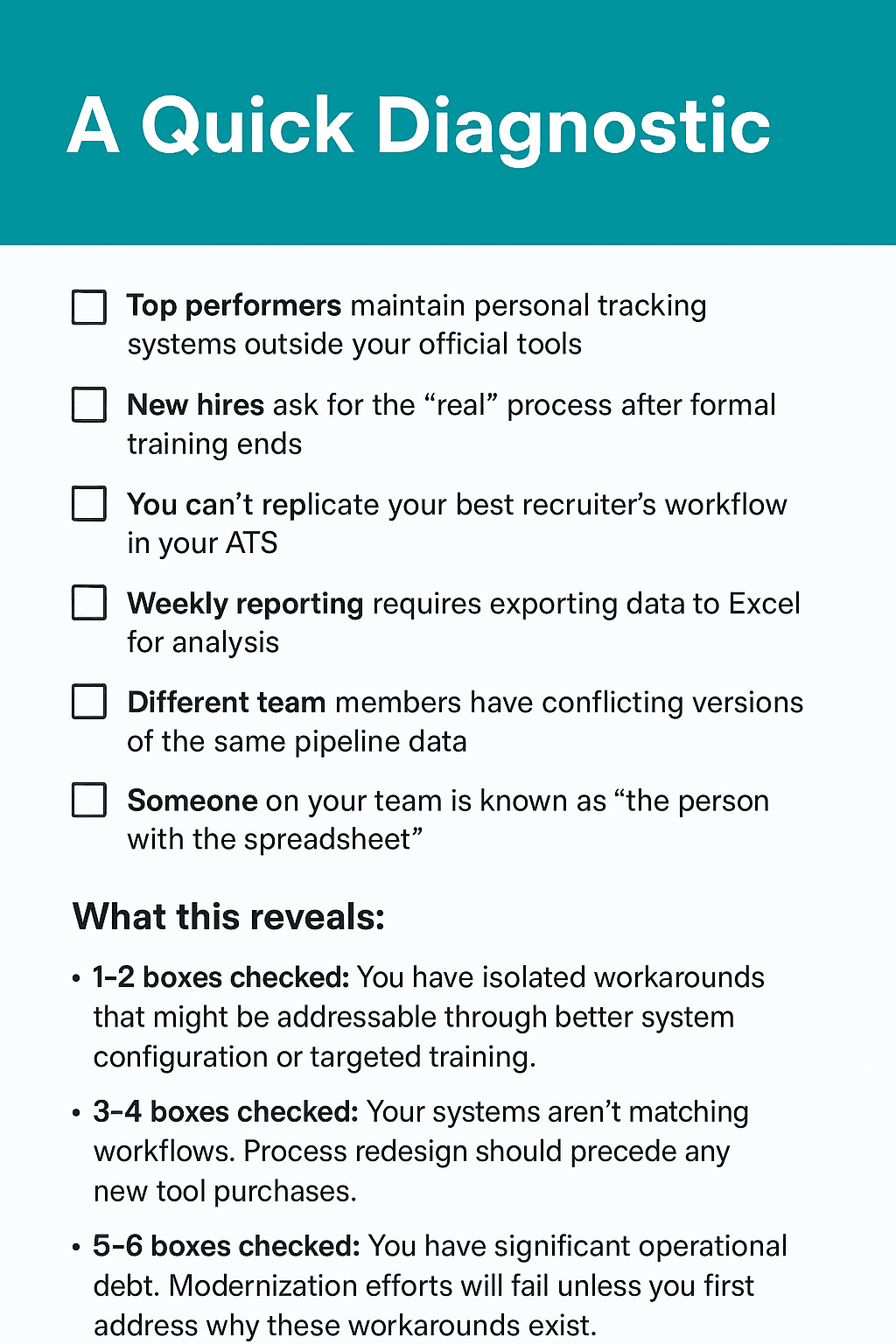
The cost of leaving these patterns unaddressed compounds over time. Organizations that maintain high-quality data in their hiring systems see 25 percent faster time-to-fill on average.2 When critical information lives in disconnected spreadsheets instead of integrated systems, every placement takes longer and creates more opportunity for competitors to move faster.
Research also found that 88 percent of spreadsheets contain errors.3 The manual tracking system that feels more reliable than your ATS is likely introducing mistakes you can’t see; mismatched availability dates, outdated contact information, or incorrect skill tags that cost placements.
Read More: 10 Practical Starting Points for Your Staffing Firm’s AI Journey
How to Modernize Without Recreating the Same Problems
Successful modernization requires understanding why workarounds exist before implementing new systems.
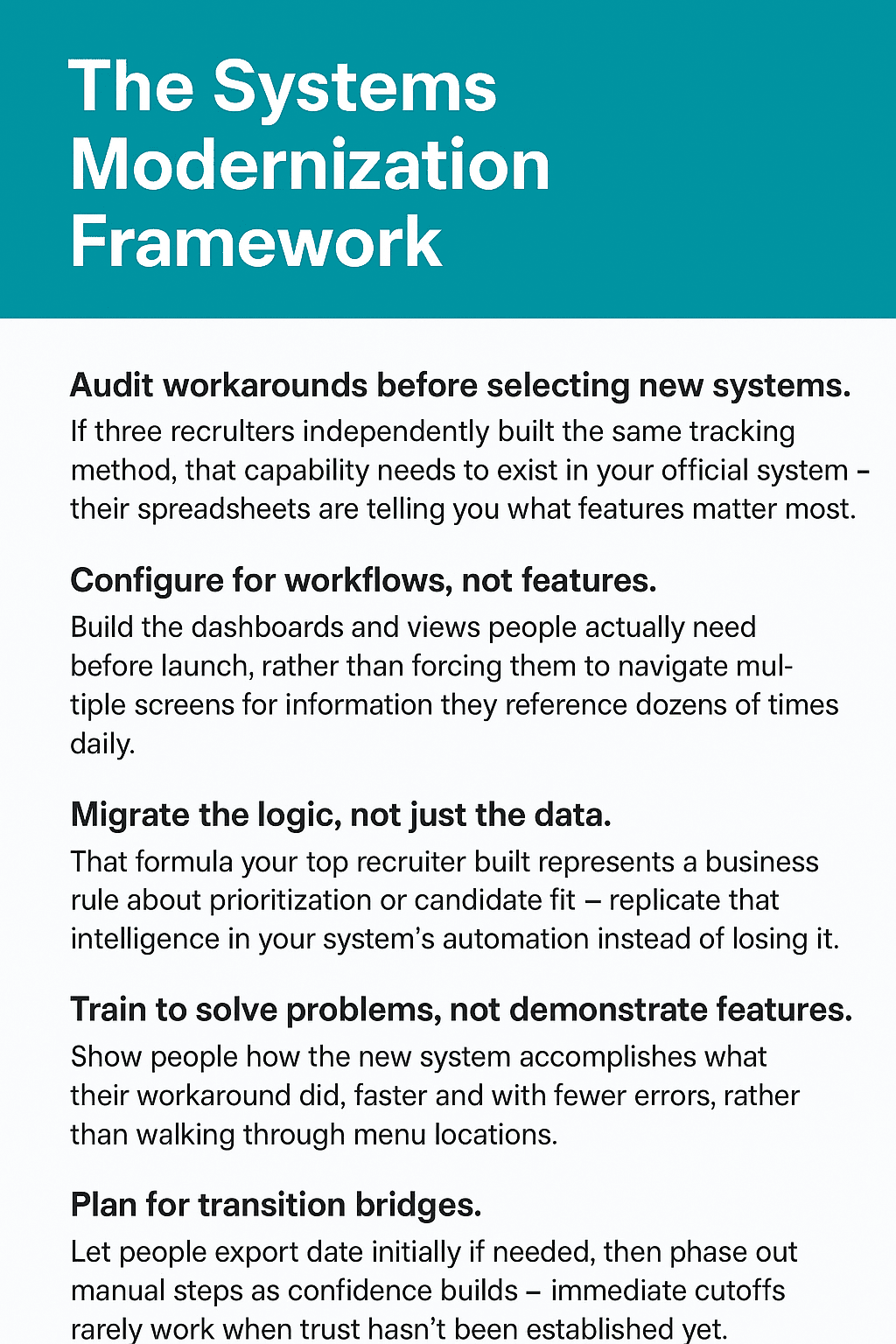
Making Technology Adoption Stick: Change Management Strategies That Work
Successful modernization depends less on the technology selected and more on how implementation addresses the human factors that created workarounds initially.
Read More: AI Enablement for Staffing Firms: How to Tell If Your Firm Is Truly Ready to Automate
Involve Workaround Builders in System Design
The recruiters who built spreadsheet solutions understand gaps in your current systems better than anyone. These individuals aren’t resistant to technology; they’re solving real problems your official tools couldn’t address.
Involving them in configuration and testing ensures the new system actually handles the workflows that drove workarounds. Their participation also creates internal advocates who can explain to peers how the modernized system solves problems they all experienced.
Phase Implementation by Workflow, Not Department
Rolling out complete end-to-end processes produces better results than department-by-department deployment. When you implement candidate sourcing, screening, and submission as one connected workflow, users see how the system supports their actual work.
Splitting implementation by team creates confusion when some people can complete processes while others still operate in the old system, forcing temporary workarounds that often become permanent.
Measure Outcomes, Not Adoption Rates
High login rates don’t indicate successful modernization if people are simply accessing the system to export data into spreadsheets. Track metrics that matter: faster time-to-fill, fewer duplicate candidate submissions, reduced errors in placement paperwork.
When teams see that the new system actually improves their results rather than just changing their tools, adoption becomes self-reinforcing rather than mandated.
Create Feedback Loops That Catch Problems Early
When someone rebuilds a workaround after launch, that signals a system gap requiring attention rather than a training failure. Establish regular check-ins during the first 90 days specifically to surface where the new system isn’t meeting workflow needs. Early course corrections prevent temporary workarounds from becoming permanent shadow processes that undermine your modernization investment.
Redesign Workflows That Actually Stick
Technology modernization fails when it focuses on replacing tools without addressing why workarounds existed in the first place. Newbury Partners specializes in implementations that eliminate the operational gaps driving manual processes.
We don’t just configure systems ; we redesign workflows to match how your team operates, ensuring adoption happens because the technology genuinely works better than the spreadsheets it replaces.
Contact us today to build a systems modernization strategy that your team will actually use.
References
1., 3. Ripla, Andre. “How Business-Led Workarounds Create Long-Term Tech Burdens.” LinkedIn, 10 May 2025, https://www.linkedin.com/pulse/how-business-led-workarounds-create-long-term-tech-andre-cuhke/.
2. Using Data to Make Better Hires. (2023, December 21). Society for Human Resource Management. https://www.shrm.org/topics-tools/news/talent-acquisition/using-data-to-make-better-hires