

Commissions accuracy is not a software problem for most staffing firms. It is a data problem that better software cannot fix. Even the best commission automation produces wrong results when placement records are incomplete, split assignments are inconsistent, or finance data does not sync. Before investing in new platforms, examine whether your underlying data can support automated calculations.
Commission data errors create different problems than typical CRM data issues because they affect recruiter paychecks directly. A missing contact field delays a report. A missing split percentage delays a paycheck. When you automate commissions, you surface data problems that manual processes have been obscuring. Those problems show up in every pay period, not just analytics dashboards.
Why Commission Data Errors Are Different (And More Damaging)
Data quality issues in CRM systems cause reporting problems. Commissions accuracy failures hit differently than other data problems because they affect recruiter paychecks directly and immediately.
CRM Data Errors Show Up in Reports. Commission Data Errors Show Up in Paychecks
CRM data issues surface when someone pulls analytics, sometimes weeks or months after entry. Commission data issues surface every pay period when recruiters compare earnings to expectations. The feedback loop is immediate and personal.
Research shows that 64% of employees experience financial stress from paycheck errors or delays, and 53% would consider leaving if payroll problems continue.1 Commissions accuracy is not an analytics problem. It is a trust problem that surfaces every single pay period.
Recruiters Notice Every Single Discrepancy Because It Affects Their Money
Unlike marketing data where errors might go unnoticed, commission errors get caught immediately. Recruiters track their own earnings, comparing placements to commissions received. When automated systems produce different numbers, trust erodes instantly.
Consider the broader context: 43% of chief operations officers identify data quality as their top priority, and over 25% of organizations lose more than $5 million annually due to poor data quality.2 In commissions, these losses manifest as recruiter disputes, finance reconciliation time, and talent retention problems.
Five Data Issues That Break Automated Commissions
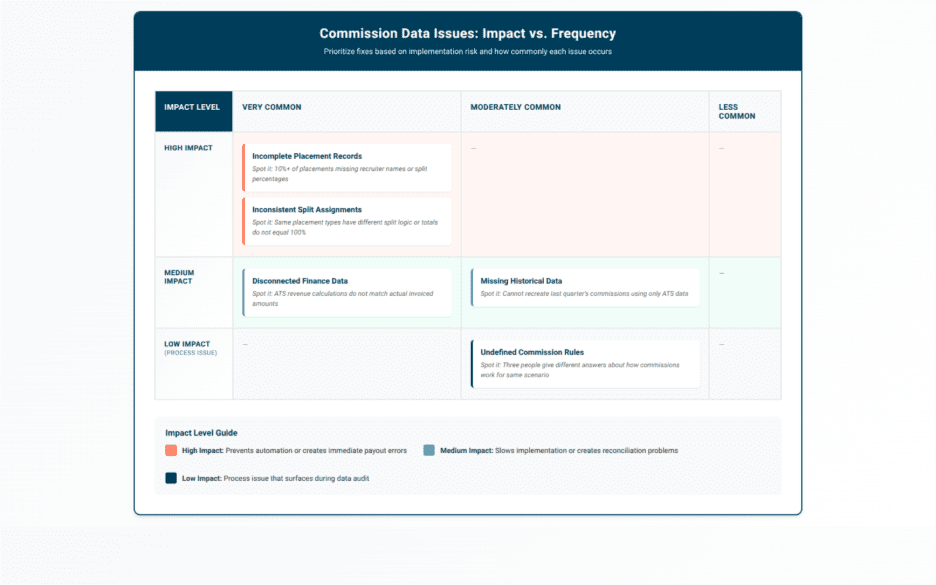
These are the data problems that surface immediately when firms attempt to automate commissions, ranked by how frequently they derail implementations. Commissions accuracy depends on resolving these data problems before configuration begins, not after.
Incomplete Placement Records Make Attribution Impossible
Placements exist in your ATS but lack complete attribution missing recruiter assignments, incomplete split percentages, or partial role assignments. Run a report of last quarter’s placements. If more than 10% are missing recruiter names or split percentages, you have this issue. Without complete attribution, commissions accuracy is impossible regardless of which platform you implement.
Inconsistent Split Assignments Create Payment Disputes
Identical placement types have different split logic applied, or splits do not total 100%. Review split patterns across similar placements. Wide variation signals missing or inconsistently applied business rules. This creates immediate payout errors that damage recruiter trust. Multi-branch firms and companies with acquisition history encounter this frequently.
Disconnected Finance Data Means Your Numbers Never Match
Placement data in your ATS does not sync with billing data in your accounting system. Commission calculations based on ATS revenue do not match actual invoiced amounts.
Reconciliation activities account for 30-40% of back-office labor costs, and inaccurate reconciliation has caused financial discrepancies reaching $95 million in recent industry cases.3 Firms using separate systems for operations and finance without integration face this regularly.
Missing Historical Data Prevents Validation
You cannot produce clean commission data from previous quarters to test automation against known outcomes. Attempt to recreate last quarter’s commissions using only ATS data. If you cannot match actual payouts, your historical data has gaps. This slows implementation because you cannot validate whether automated calculations are accurate.
Undefined Commission Rules Hiding as “We Just Know”
Edge cases get handled ad-hoc, exceptions remain undocumented, and verbal agreements govern how splits work. Ask three people in your organization how commissions work for the same scenario. Different answers reveal undefined rules. This surfaces during data audit and stalls implementation.
Why Data Assessment Must Come Before Implementation
Vendors who discover data problems mid-implementation either charge change orders or deliver systems that Protecting commissions accuracy from day one requires identifying data gaps before a single rule is configured. The right approach identifies these issues upfront.
Assessment Determines Which Automation Architecture Actually Fits
Perfect commission logic on broken attribution data fails regardless of platform. Before choosing between ATS-native automation, bespoke engines, or analytics-driven solutions, evaluate your data foundation. This assessment reveals what data work must happen before configuration begins.
ATS-Native Implementations Require Source Data Validation First
Fast implementations using platforms like Bullhorn Canvas depend on clean placement records and standardized split assignments. Firms that validate data before configuration achieve 1-3 week timelines with accurate results.
Firms that skip validation spend months troubleshooting failed calculations. Automated reconciliation can achieve 60-80% productivity improvements, but only when source data is reliable.4
Complex Architectures Demand Integration Planning
Bespoke commission engines and analytics platforms pull data from multiple systems. Integration planning identifies which sources need to connect, where data gaps exist, and what synchronization rules prevent future discrepancies. This happens before building anything.
Implementation Partners Either Fix Data Problems or Ignore Them
Some vendors configure systems exactly as specified and deliver broken results when data issues surface. The better approach treats data assessment as the first implementation phase. Firms working with partners who identify data gaps before configuration avoid months of post-implementation fixes.
Start with Data, Not Software
Commissions accuracy starts with data quality, not software selection. The best automation platforms cannot overcome incomplete placement records, inconsistent split assignments, or disconnected finance data. Newbury Partners can help you fix both.
Before we implement your automated commissions system, we assess and clean your data foundation to ensure accuracy from day one. Schedule a data readiness assessment to start your commissions transformation the right way.
References
1. Warner, Carol. “New Study: Payroll Mistakes Create Turnover Risk for 53% of Workers.” HR Morning, 17 Sept. 2025, www.hrmorning.com/news/payroll-mistakes-hr-finance/.
2. Krantz, Tom, and Alexandra Jonker. “A Compounding Threat: The True Cost of Poor Data Quality.” IBM Think, 23 Jan. 2026, www.ibm.com/think/insights/cost-of-poor-data-quality.
3. Revolutionizing Payment Operations with Real-Time Reconciliation.” BAI, 8 May 2025, www.bai.org/banking-strategies/revolutionizing-payment-operations-with-real-time-reconciliation/.