

Bullhorn post-implementation drift is not the result of a single decision or a visible failure. It is the distance that accumulates quietly between what the platform was configured to do and what it actually does day to day.. Nothing is broken. Support tickets are not piling up, and no one is raising alarms.
But somewhere along the way, the gap between what the platform was configured to do and what it actually does day to day has widened, quietly enough that no single moment marked when it happened.
You can sense it before you can name it. A workflow that used to save time now gets worked around. A feature your team paid for sits unused. This piece gives you a way to measure that gap instead of just sensing it.
Where Drift Accumulates Inside a Bullhorn Environment
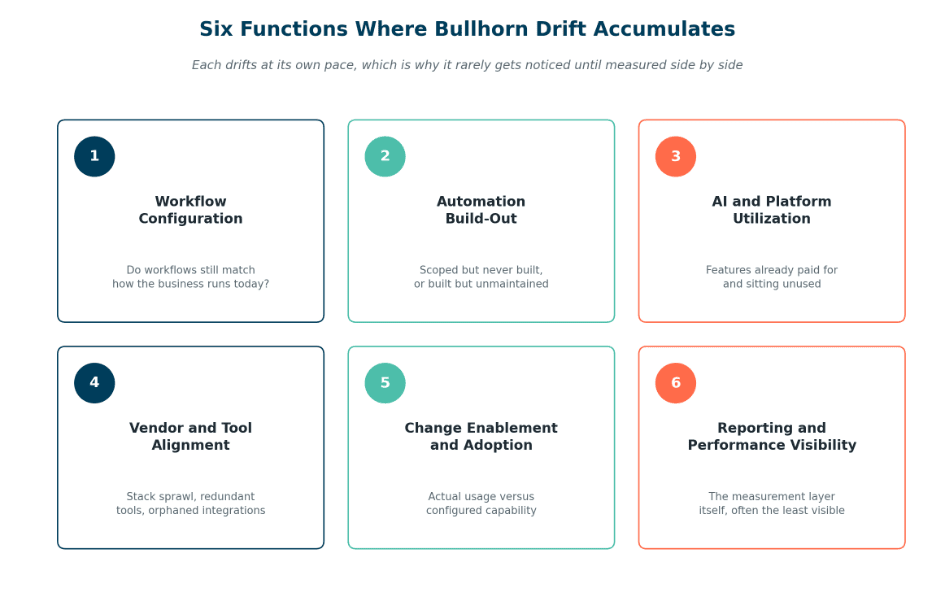
Bullhorn post-implementation drift shows up across several functions at the same time, each drifting at its own pace and rarely in a way that gets noticed until the functions are looked at side by side.
Some of it lives in configuration, where workflows built for how your firm operated at go-live no longer match how your team actually works today. Some of it lives in what never got built in the first place, automations that were scoped but shelved, quietly generating manual workarounds instead.
Some of it lives in the platform itself, features you are already paying for that no one on your team has adopted. The functions differ, but the pattern holds across all of them: capability exists, and daily use has fallen behind it.
How Wide the Gap Gets
Firms tend to underestimate this gap simply because they cannot see all of it from the inside.
The Visibility Gap Is the Starting Point
Most organizations are aware of less than half of what is active in their own technology environment. Up to 25 percent of provisioned software licenses go unused, and organizations are typically aware of only 40 percent of the applications running across their environment.1
Bullhorn is rarely an exception to this pattern. If your team cannot see the full extent of what is configured versus what is used, drift does not just continue. Bullhorn post-implementation drift does not just continue when it goes undetected. It compounds quietly because no one inside the environment is positioned to see the full extent of it.
The Gap Is Wider Than a General Sense the Environment Can Show
Bullhorn post-implementation drift stays diffuse until someone maps current state against a defined standard, because none of the individual gaps register as a single problem on their own. Without that mapping, drift stays diffuse: a workflow that feels a little slow here, a feature nobody quite remembers exists there.
None of it registers as a single problem because none of it is a single problem. A workflow that quietly went stale in one function compounds with an unused feature in another, and neither shows up as an issue on its own. Measurement is what puts them side by side, where the pattern becomes visible instead of assumed.
What Measurement Changes Once the Gap Is Visible
Quantifying Bullhorn post-implementation drift shifts the conversation from whether a problem exists to what to address first and in what order.
A Baseline Changes What Gets Prioritized First
Without a baseline, Bullhorn post-implementation drift gets addressed by whoever complains loudest rather than by which gap is costing the most in hours, errors, or unused capacity. Once you have a measured baseline across all six functions, prioritization becomes a comparison instead of a guess.
You can see which function has drifted furthest from its configured capability, which gap is costing the most in hours or errors, and which fix would free up the most capacity for the next one. That clarity is the direct product of measurement, not something you had access to before it.
Recovery Moves Faster Than Most Teams Expect
There is a common assumption that once drift is quantified, the recovery process will be slow and disruptive, because the gap turned out to be larger than expected. In practice, the opposite tends to be true. A measured baseline tells you exactly where to start, which means the first fixes can move quickly because no one is spending time figuring out where to look.
Momentum builds faster when effort is aimed at a known target instead of split across a general sense that things could be better.


Fixing Drift Doesn’t Mean Starting Over
The instinct to treat Bullhorn post-implementation drift as a reason for a full rebuild is understandable, and it is also the wrong response.
The instinct to treat a wide gap as a reason for a full rebuild is understandable, and it is also the wrong response. Drift accumulates function by function, which means it can be corrected function by function. A workflow that has gone stale can be reconfigured without touching the automations that are still working.
A feature that is going unused can be adopted without a platform migration. Recovering from drift means closing specific gaps in a defined order, not discarding what is already functioning and starting from a blank environment.
Get a Documented Baseline for Where Your Environment Has Drifted
Knowing that drift exists across six functions is different from knowing which ones apply to your environment and by how much. Request a Navigator Scope Coverage Audit, and Newbury Partners will map your current Bullhorn environment against a defined standard, function by function, so you have a documented baseline instead of a general sense that something has slipped.
Request a Navigator Scope Coverage Audit
Reference