

ATS implementation recovery starts with a question most firms never formally ask: is your system actually delivering, or just running? That question does not come up until something visibly breaks. And by then, the gap has usually been open for a long time.
That gap between technically operational and actually performing is where most ATS underperformance lives. It does not announce itself as a failure. It shows up as friction; small workarounds, shallow adoption, and data you cannot quite rely on. And because none of it feels urgent enough to escalate, it stays. The question is not whether your ATS is broken. It is whether it is quietly costing you more than you realize.
Why Your ATS Underperforms Without Ever Breaking Down
ATS implementation recovery addresses the gradual erosion that firms normalize long before anyone thinks to question it. Most firms expect failure to announce itself. It rarely does. The more common pattern is gradual erosion that gets normalized before anyone thinks to question it.
The workarounds have become the workflow.
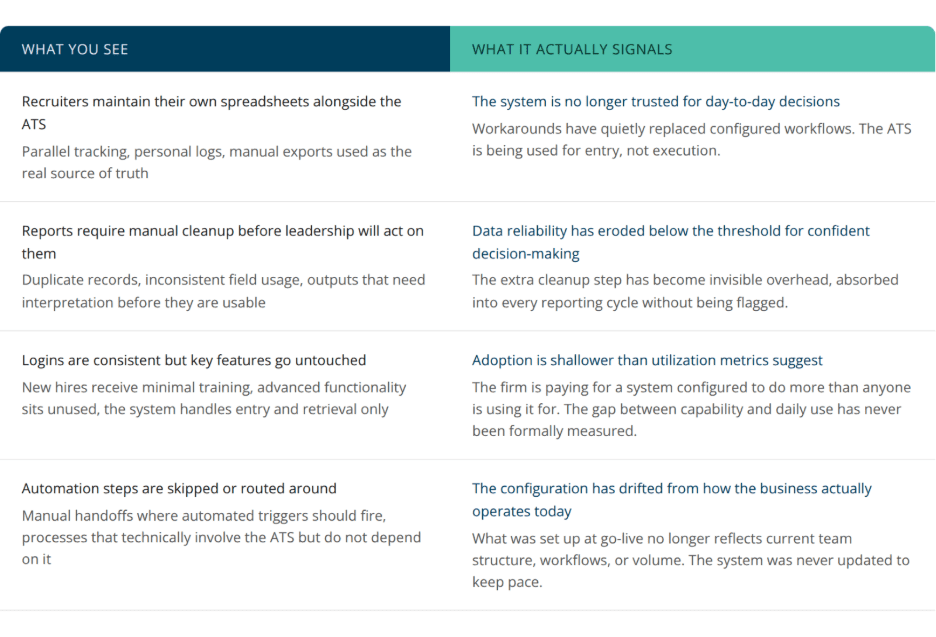
The clearest sign that an ATS has drifted is not what recruiters are doing inside the system. It is what they are doing outside of it. Spreadsheets maintained in parallel, manual steps inserted where automation was supposed to run, processes that technically involve the ATS but do not depend on it. Each workaround started as a temporary fix. Over time, it became standard practice.
ATS implementation recovery begins by tracing those workarounds back to the configuration decisions that made them necessary in the first place.
The data has quietly stopped being trustworthy.
Duplicate records accumulate. Fields get used inconsistently across the team. Reports require manual cleanup before anyone will act on them. None of this registers as a system failure because the ATS is still generating output. The problem is that the output requires interpretation before it is usable, and that extra step becomes invisible overhead absorbed into every reporting cycle.
When data cannot be trusted at face value, decisions slow down. And the people closest to the data are usually the last ones to flag it because they have already learned to work around it.
Adoption is shallower than anyone has measured.
Logins are not the same as utilization. A recruiter can open the ATS every day and still only use a fraction of what it was configured to do. Key features go untouched, new hires receive minimal training on anything beyond the basics, and the system gets used for entry and retrieval rather than the workflow automation it was built to support.
The gap between configured capability and actual daily use is rarely tracked formally. Which means most firms are carrying a system that is more capable than anyone realizes and getting less from it than they are paying for.
Why the Answer Is Not a New System
The instinct to scrap and replace is understandable. ATS implementation recovery makes the case that the platform is rarely the problem, and replacement rarely the answer.
The gaps follow the firm, not the platform.
ATS implementation recovery works because the gaps that cause underperformance are ownership and configuration problems, not platform ones. They are ownership and configuration problems. A new system inherits them on day one because the underlying habits, training gaps, and process decisions that created them come with the firm, not the software.
Replacing the ATS without addressing those conditions means running the same implementation a second time and expecting a different result.
Replacement costs more than it saves.
A new ATS means data migration, retraining, lost productivity during transition, and months before anyone is fully operational again. That disruption lands on top of a problem the new platform will not automatically solve. If your firm is already experiencing friction in its current system, adding the operational weight of a full replacement rarely produces the clean slate it promises.
The investment already made is closer to working than it looks.
Nearly 29 percent of SaaS software spend is underutilized or wasted.1 For a firm already paying for an ATS it is not fully using, recovery works with that existing investment. Replacement abandons it entirely. In most cases, the configuration, the data, and the workflows are further along than they appear. What is missing is not a new platform. It is a structured process for closing the gaps that opened after go-live.
What recovery actually requires.
ATS implementation recovery requires a structured audit, not a replacement budget. Closed workflow gaps. Defined ownership. Targeted fixes rather than wholesale change. The path forward does not begin with a new platform. It begins with an honest assessment of what broke down, where adoption stalled, and what the system was never properly set up to do in the first place.
Is Your ATS Running but Not Delivering?
ATS implementation recovery closes the distance between how your system was configured and how it is actually being used today, without the disruption or cost of starting over. It is the distance between how the ATS was configured and how it is actually being used today. That distance is closeable.
At Newbury Partners, we start with a diagnostic that identifies where the gaps actually are, not where they appear to be. From there, the work is targeted: closing workflow gaps, restoring data reliability, and rebuilding adoption around what the system was already configured to do. No replacement required. If your ATS is running but not delivering, reach out to us today.
Reference
1. Torres, Roberto. “Nearly One-Third of SaaS Spend Goes to Waste, Survey Says.” CIO Dive, 14 Oct. 2021, www.ciodive.com/news/saas-spend-control-enterprise-flexera/608257/.