

So, you have decided to automate commissions. Now comes the architecture question: Should ATS commissions handle your calculations inside Bullhorn, or do you need a separate system? This decision determines your implementation timeline, ongoing costs, and whether your solution scales with future complexity.
Workflow software integration fails nearly 68% of the time, often because firms misalign solution architecture with their actual complexity.1 Simple structures waste money on over-engineered solutions, while complex logic breaks when forced into inadequate tools.
The right architecture depends on your commission structure, firm size, and analytics needs. Most staffing firms should start with ATS-native commissions like Bullhorn Canvas. Some need dedicated bespoke engines. A few require BI Portal integration.
When should ATS commissions handle your calculations?
ATS commissions work best when your structure follows straightforward, rule-based logic with standard splits and overrides. ATS-native commissions like Bullhorn Canvas work best for firms where commission calculations can be tracked in a single spreadsheet tab and do not require data from external systems.
Single-Division Firms with Standard Structures
Characteristics that fit ATS-native commissions:
- Universal commission rates across all recruiters (e.g., flat 8% on all placements)
- Simple tiered structures (e.g., 5% up to $50K placed, 7% above)
- Standard splits for team deals (e.g., 60/40 or 50/50)
- Single brand or division
- Commission rules stable month-to-month
Example: A 30-person recruiting firm with one office and consistent 8% commissions implemented Bullhorn Canvas in 2 weeks. Finance exports monthly totals for payroll processing.
Multi-Office Firms with Consistent Rules
ATS-native still works when:
- Multiple offices use the same commission structure
- Regional differences are minimal (e.g., different tax treatment, same commission logic)
- All data needed for calculations already lives in your ATS
- Team size under 100 recruiters
ATS-native commission systems take 1-3 weeks to implement compared to months for custom builds. Firms moving from manual to automated calculations save 6-10 hours per week per recruiter. For a 50-person team, that represents 300-500 hours monthly redirected from spreadsheet management to revenue-generating activities.
The key question is whether your commission logic fits within what your ATS can handle natively. When complexity exceeds those boundaries, you need different architecture.
What are the limits of ATS-native commissions, and when do you need something else?
ATS-native commissions hit technical limits when your logic requires weighted attribution across multiple contributors, complex multi-variable tiering, or data from systems outside your ATS. These constraints become operational problems when your finance team creates manual workarounds every cycle.
Technical limits of ATS-native commissions:
- Cannot handle weighted multi-contributor attribution (e.g., 40% sourcing recruiter, 30% account manager, 30% closer)
- Struggles with complex tiering that changes based on multiple factors (client tier × placement type × recruiter tenure)
- Limited to data inside your ATS (cannot pull margin data from separate billing systems or performance metrics from other platforms)
- Difficult to accommodate different commission plans across multiple brands or subsidiaries
- No predictive analytics or forecasting capabilities
- Cannot easily handle mentor bonuses, team override structures, or matrix-based compensation plans
Warning signs you have outgrown your ATS:
- Finance team creates manual overrides in spreadsheets every commission cycle
- Commission logic requires external calculations despite having automation
- Recruiters regularly dispute calculations because the system cannot show weighted attribution
- You are managing different commission structures across divisions and the ATS cannot accommodate variations
- Your commission plan has more than 3-4 variables that interact
- These warning signs often accumulate gradually until firms realize their commission process has become unmanageable. One national staffing firm reached this breaking point when their workarounds became more complex than the problem they were trying to solve.
Case Study: When Spreadsheets Signal You Need More
A national staffing firm came to Newbury Partners with a 60-tab commission spreadsheet and 10-15 days of monthly manual work. Their structure included variable burdens by location, different tiers per division, and matrix-based plans the ATS could not handle. A bespoke commission engine delivered an 80% reduction in calculation time with zero missed payments.
Moreover; the wrong architecture is expensive to fix. One retailer lost $150,000 in 18 months after implementing software that could not meet their requirements.2 When you hit these limits, you need either a dedicated bespoke commission engine or BI Portal integration, depending on your IT resources and analytics needs.
How do you choose between ATS-native, bespoke, and BI Portal commissions?
Your choice depends on three factors: commission complexity, internal IT capabilities, and whether you need commissions integrated with broader business analytics. Here’s how each architecture maps to different organizational needs.
ATS-Native Commissions (Bullhorn Canvas)
Best for:
- Straightforward commission structures with standard splits
- Firms under 100 recruiters with single brand or division
- Organizations wanting fast implementation without custom development
- Commission rules that can be tracked in one spreadsheet tab
Timeline: 1-3 weeks implementation
Investment level: Lowest tier (implementation fees only)
IT requirements: None beyond existing ATS
Key advantage: Works within your existing Bullhorn environment with no additional systems to manage
Bespoke Commission Engines
Best for:
- Complex multi-variable commission formulas
- Weighted attribution across multiple team members
- Different commission structures across brands or subsidiaries
- Firms with internal IT or development teams who want to own infrastructure
Timeline: Custom (typically 8-12 weeks depending on complexity)
Investment level: Mid-to-high tier (custom development)
IT requirements: Internal team to manage and maintain long-term
Key advantage: Unlimited flexibility to accommodate any commission logic, fully customized to your exact requirements
BI Portal with Commission Module
Best for:
- Firms needing strategic analytics beyond just commission calculations
- Organizations wanting predictive forecasting and performance benchmarking
- $25M-$125M revenue firms without internal data engineering resources
- Leaders who need commissions integrated with sales, operations, and finance dashboards
Timeline: Turnkey platform (4-6 weeks for data integration)
Investment level: Subscription-based managed service
IT requirements: None—Newbury hosts infrastructure
Key advantage: Commissions become part of comprehensive business intelligence without building data warehouse internally
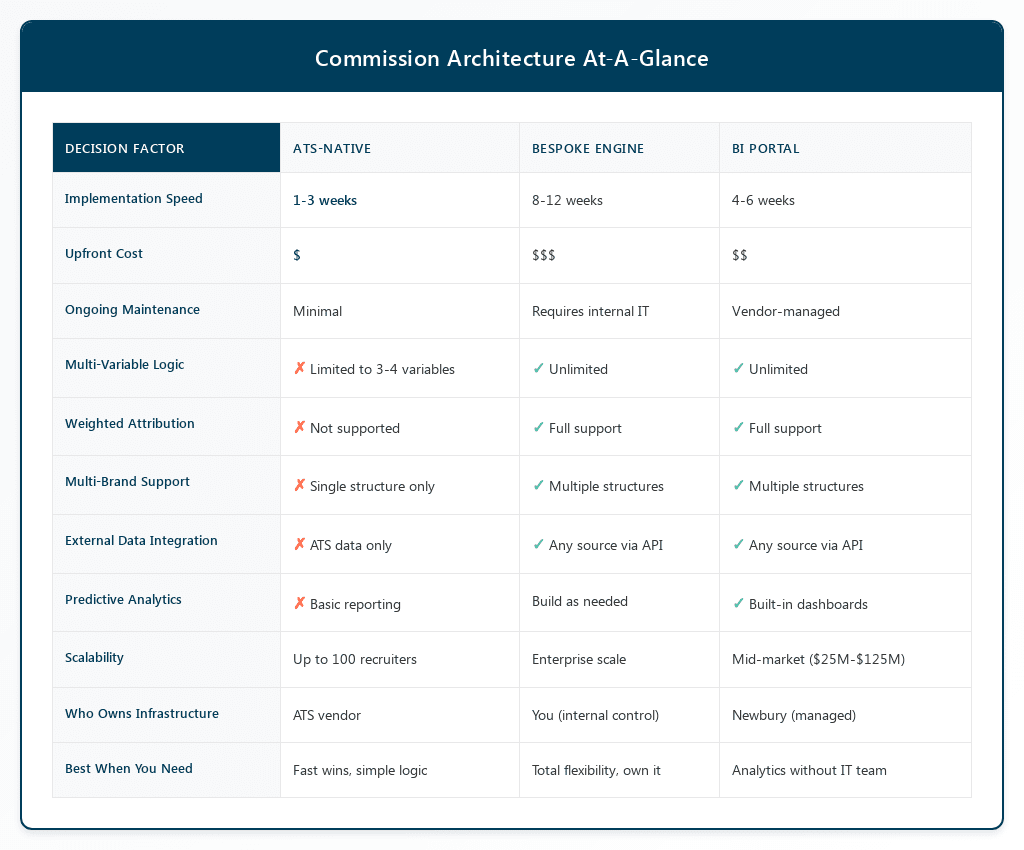
The comparison matrix below shows these three architectures side-by-side for quick reference.
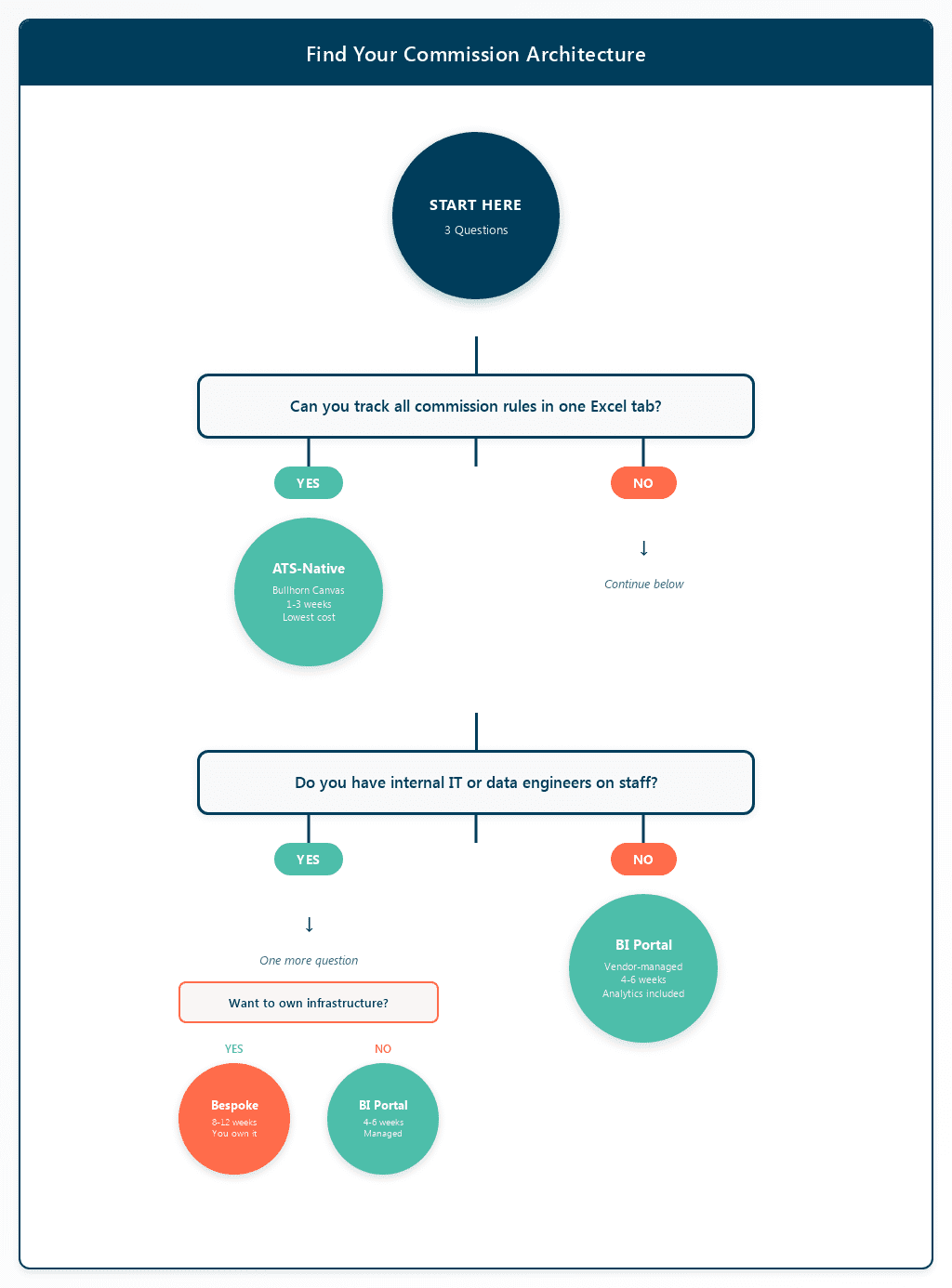
If you need help determining which architecture fits your specific situation, this decision tree guides you through three diagnostic questions to identify your best path forward.
Ready to Choose the Right Commission Architecture?
Choosing between ATS-native commissions and a dedicated solution depends on your firm’s structure, scale, and strategic goals. Newbury Partners helps staffing firms make this decision with clarity and implements the right solution fast.
We start with ATS commissions for most firms, offer bespoke engines for complex needs, and provide BI Portal integration for analytics-focused organizations. Contact us for a solution assessment.
References
1. Radulovic, Alex. “The Hidden Costs of Choosing the Wrong Software for Your Business: Using Workflow Tools Can Be Counterproductive If Not Done Correctly.” In Business Phoenix, www.inbusinessphx.com/technology-innovation/the-hidden-costs-of-choosing-the-wrong-software-for-your-business.
2. Saunders, Jason. “Choosing Wisely: The High Cost of Selecting the Wrong Software for Your SMB.” LinkedIn, 9 Apr. 2025, www.linkedin.com/pulse/choosing-wisely-high-cost-selecting-wrong-software-your-saunders-cjphc/.