

If someone asked you right now who owns Bullhorn’s performance at your firm, would one name come to mind, or would the honest answer depend on who happened to have time that week? And if you looked back at the last quarter, would you find a scheduled review of what the platform returned, or only a series of conversations that happened because something broke?
These two questions are worth sitting with honestly, because the answers tend to say more about how your Bullhorn investment is actually performing than the size of the budget behind it.
What Two Markers Separate High-Performing Firms
Bullhorn performance at high-performing firms is a discipline with a name attached to it and a fixed point on the calendar, not a default that emerges from platform investment alone.
Ownership Has a Name, Not a Committee
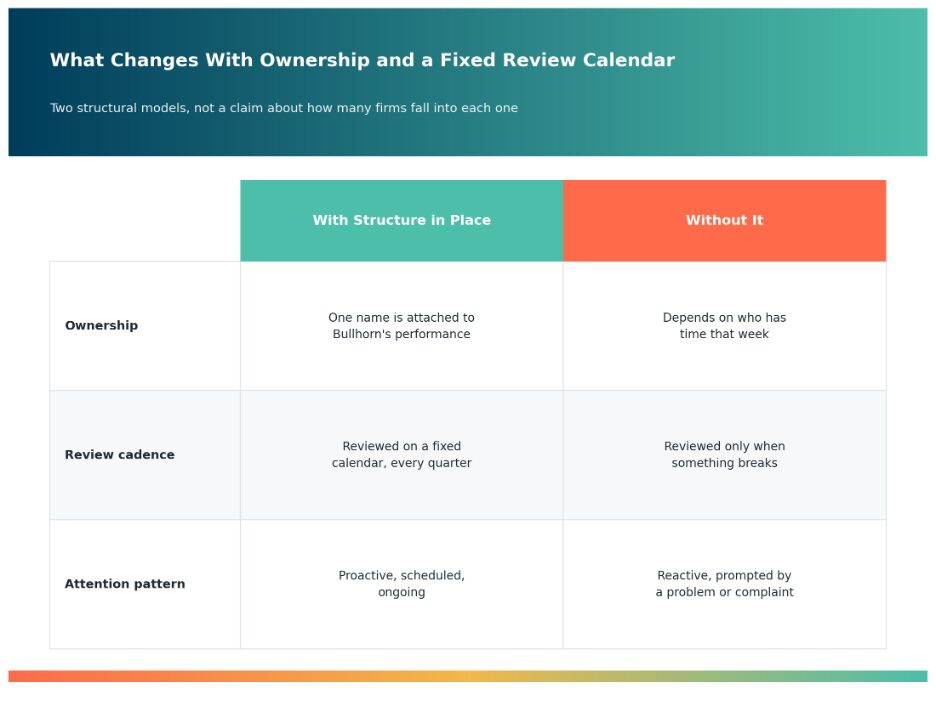
At firms where Bullhorn performance is treated as a discipline, one person’s name is attached to it. That person is accountable for whether the platform is being optimized, not just maintained, and everyone else in the firm knows who that person is.
Where ownership is diffused across a committee or whoever has bandwidth that month, Bullhorn performance becomes something that happens when someone finds time for it rather than something anyone is answerable for.
Performance Gets Reviewed on a Calendar, Not by Exception
The second marker of a firm that treats Bullhorn performance as a discipline is whether its return gets reviewed on a fixed schedule or only surfaces when something goes wrong. A calendar-driven review means someone is looking at what the platform produced whether or not there was a problem to prompt the conversation.
Reactive-only attention means the platform’s performance only becomes visible in response to a complaint, a missed deadline, or a budget conversation that was already going to happen anyway.
Why Structure Predicts Performance and Budget Size Doesn’t
Bullhorn performance is not a function of how much is invested in the platform. It is a function of whether that investment operates inside a structure built to convert spending into results.
Structure, Not Budget Size, Is What the Data Shows
Organizations that redesigned their operating model around clear structure, governance, and accountability, rather than simply increasing spend, saw technology ROI increase by up to 25 percent and speed to market improve by up to 40 percentage points.1
The lever that separates firms with strong Bullhorn performance from those still waiting for the investment to pay off is not the size of the budget. It is whether the budget operates inside a structure that converts spending into results.
Unowned Budget Doesn’t Convert Into Results
Bullhorn performance does not improve when budget exists without ownership, because a line item on a budget is not the same as someone being accountable for deploying it toward a result. Without a name attached to the outcome, that budget tends to sit unspent or gets quietly absorbed into whatever feels most urgent that week.
The money existing on a budget line is not the same as the money producing a result, and the gap between the two is almost always a question of ownership, not amount.
Structure Is Also What Makes the Investment Visible
Named ownership and a fixed review calendar do more than drive optimization forward. They also make the investment visible to finance in the first place. Firms with both in place are typically the same firms whose finance leaders can answer basic Bullhorn ROI questions with data, a visibility gap already explored in “3 Bullhorn CFO Metrics Most Finance Teams Cannot Pull Today.” (insert blog url when live)
Structure and visibility tend to arrive together, because the same discipline that assigns ownership and sets a review calendar is what forces the underlying numbers to exist in the first place.
Where Does Your Environment Actually Stand?
These questions give you an honest read on where your Bullhorn performance discipline actually stands, and the value is in answering them directly rather than counting how many land in your favor.
Is there one person whose name is attached to Bullhorn’s performance, or does the honest answer depend on who happens to have time that week. Does anyone review Bullhorn’s return on a fixed calendar, or does it only come up as a topic when something breaks.
And if your finance team was asked right now what Bullhorn returned last quarter, could they answer without pulling anything manually, or would someone need to go build that answer first.

Request a Navigator Scope Coverage Audit
Bullhorn performance is not something a self-administered checklist can fully measure. It does not give you a number. Request a Navigator Scope Coverage Audit and get a direct comparison between your current environment and what a structured, well-owned Bullhorn operation actually looks like, backed by an assessment of your own environment rather than a self-administered checklist.


Request a Navigator Scope Coverage Audit
Reference
1. McKinsey & Company. “A New Operating Model for a New World.” McKinsey & Company, www.mckinsey.com/capabilities/people-and-organizational-performance/our-insights/a-new-operating-model-for-a-new-world.