

Are your recruiters spending more time navigating between systems than actually placing candidates? Do reports that should take minutes require pulling data from multiple tools and reconciling it manually in Excel? When leadership asks why placements are slowing, is the answer always some version of “our systems just don’t work together”?
The instinct might be to replace everything, or staffing systems reset, but 77 percent of enterprises still rely on systems over 10 years old for core operations. And average system replacements take 18-36 months and cost 2-5x initial estimates.¹ A staffing systems reset doesn’t mean starting from scratch but identifying where workflows break and fixing those specific problems without replacing everything.
Why a Staffing Systems “Reset” Doesn’t Mean “Replace Everything”
When recruiters complain about the ATS, operations teams start researching alternatives. When reports require manual data reconciliation, leadership considers platform migrations. A staffing systems reset means optimization, not replacement, fixing how systems work together and how people use them, not abandoning core platforms.
- Reset means optimization, not replacement. You’re fixing how systems work together and how people use them, not abandoning core platforms. Most staffing firms solve workflow problems by improving integration between existing tools.
- Most firms already have the functionality they need. Employees spend 22 percent of their time navigating between applications and manually transferring data. The problem isn’t missing capabilities but poor adoption, inadequate training, or integration gaps that force users to work around official systems.
- Selective improvement costs less and disrupts less than full replacement. A targeted reset delivers measurable improvements in weeks or months, not years, while maintaining productivity during transition.
- You can reset workflows without changing core systems. When recruiters build spreadsheet workarounds, the problem is rarely that your ATS lacks functionality. More often, the ATS isn’t configured to match how your team works, required fields create friction, or integration gaps force manual data entry.
A targeted staffing systems reset delivers measurable improvements in weeks or months, not years, while maintaining productivity during transition.
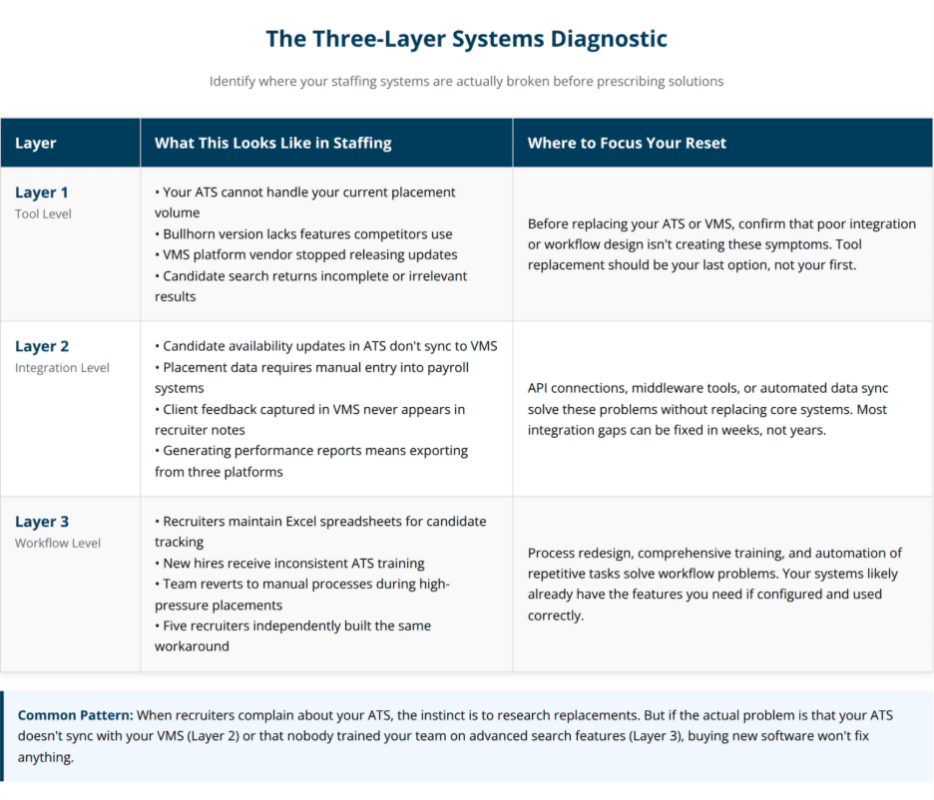
The Three-Layer Systems Audit
Before investing in fixes, diagnose where your systems are actually broken.
Read More: How to Execute a Flawless CRM Migration in Your Staffing Firm
Layer 1 – Tool Level Problems
Tool-level problems exist when software lacks necessary functionality, operates on unsupported technology, or can’t scale to your business volume. Signs include: your vendor stopped releasing updates years ago, critical features don’t exist in your platform, or the system crashes under normal load.
Most companies run systems that are 10-20 years old.2 These aren’t always broken, but they don’t deliver full value.Before concluding your tools need replacement, a staffing systems reset starts by confirming that integration and workflow aren’t the actual problems. Outdated software can often support modern workflows if properly integrated.
Layer 2 – Integration Level Problems
Integration problems occur when tools can’t communicate, creating data silos and manual transfers. Signs include: ATS updates never sync to your VMS, placement data requires manual entry into payroll, or client reports mean exporting from three platforms and reconciling in Excel.
63 percent of businesses report technical debt creates moderate to severe negative effects, with legacy technology as the leading cause. While most IT leaders say 75 percent of legacy systems can’t support AI tools.3 Integration gaps, not aging software, create the biggest barriers to efficiency.
Layer 3 – Workflow Level Problems
Workflow problems stem from how people use systems, not the systems themselves. Signs include: recruiters maintain personal spreadsheets because official processes are cumbersome, new hires receive inconsistent training, or team members build identical workarounds independently.
When your team develops shadow IT solutions during high-pressure periods, the problem is workflow design, not missing functionality. These issues require process redesign and training, not software purchases and they’re among the most common problems a staffing systems reset resolvesot software purchases.
Phased Staffing Systems Reset Strategy (How to Improve Without Operational Chaos)
Systems improvement fails when firms attempt comprehensive overhauls that disrupt operations. A phased approach fixes critical problems first, builds momentum through visible wins, and maintains productivity.
Read More: The Hidden Cost of Dirty Data (and How to Clean It Up)
Phase 1 – Stop the Bleeding (Fix Critical Bottlenecks First)
Identify workflow breakdowns costing you placements or revenue right now. A recruiter who can’t access candidate contact information loses placements. Payroll requiring manual data entry from multiple platforms creates delays that damage client relationships.
Fix problems with measurable business impact this week, not theoretical improvements for next quarter. Address the integration that fails daily before optimizing workflows that occasionally create friction. A staffing systems reset addresses the integration that fails daily before optimizing workflows that occasionally create friction.
Phase 2 – Consolidate Redundancy (Eliminate Duplicate Tools)
Audit every tool your team uses, including unofficial solutions like browser extensions and personal spreadsheets. When three recruiters independently build the same tracking spreadsheet, your official systems are missing needed functionality. When you’re paying for two platforms handling candidate communication, eliminate one.
Shadow IT signals legitimate gaps but also fragments data. Consolidation means configuring official systems to handle what shadow tools do, or formally adopting the best workaround and eliminating alternatives.
Phase 3 – Integrate Core Systems (Connect ATS, VMS, Payroll)
Build data flow automation between core platforms. Candidate updates should sync automatically from ATS to VMS. Placements should trigger payroll without manual entry. Client feedback should create recruiter notes without copy-pasting.
Integration doesn’t always require custom development. Modern platforms offer API connections and middleware for automated sync. When systems can’t integrate directly, consider whether automation justifies custom development or whether tool replacement makes more financial sense.
Phase 4 – Optimize Workflows (Train, Automate, Refine)
Redesign workflows to leverage automation. Train teams on new capabilities, document procedures, and establish feedback loops. The most sophisticated system delivers no value if your team doesn’t use it or reverts to manual methods under pressure.
Automation should handle repetitive tasks: data entry, status updates, report generation, compliance documentation. Recruiters should focus on relationship building, candidate qualification, and client development not administrative work.
Let Newbury Partners Help With Your Staffing Systems Reset Without Starting Over
When workflows feel chaotic, a staffing systems reset fixes what’s broken while preserving what works. Newbury Partners specializes in diagnosing where staffing systems fail and implementing phased improvements without operational disruption.
As Bullhorn’s #1 System Integration Partner, we help firms optimize existing platforms through better integration, workflow redesign, and targeted automation. Whether you need integration architecture, a staffing systems reset, workflow optimization, or guidance on when replacement makes sense, we turn system chaos into clarity.
References
1. Nguyen, Rita. “Legacy Systems + Modern AI: A Guide to AI Integration Without the Rip-and-Replace Nightmare.” LinkedIn, 2 July 2025, www.linkedin.com/pulse/legacy-systems-modern-ai-guide-integration-without-nightmare-nguyen-m9o8c/.
2. “Is ERP Dead? Why Incremental Modernization May Be Smarter Than a Full Replacement.” Third Stage Consulting, 8 Sept. 2025, www.thirdstage-consulting.com/is-erp-dead/.
3. “When ‘Modern’ Data Storage Becomes Legacy.”, Financial Times, (n.d.), Pure Storage, www.ft.com/partnercontent/pure-storage/when-modern-data-storage-becomes-legacy.html.