

Your recruiting team just closed a placement. Staffing SaaS integration determines whether your tools multiply each other’s value or quietly multiply your team’s workload. How long does that take? Thirty minutes? An hour? How many times does someone need to copy the same information between platforms?
You invested in excellent tools for each function, so why does completing a single placement still feel like an obstacle course? The problem might not be your individual systems but whether those systems actually work together. This is what integration debt looks like, and it compounds with every new tool you add to your stack.
What Integration Debt Actually Costs You
Staffing SaaS integration debt accumulates when you adopt best-in-class tools without accounting for the overhead of making them work together. Each new platform solves one problem but creates synchronization work, context-switching friction, and error opportunities that compound across your operation.
- Manual synchronization time. staffing SaaS integration gaps force someone on your team to spend hours each week copying candidate information between your ATS, VMS, payroll system, and client portals. This is not occasional administrative work but a recurring tax on every placement and status update.
- Context-switching tax. Your recruiters lose up to 22% of their time just navigating between different applications rather than doing actual work.1 Every platform toggle breaks focus and requires mental recalibration.
- Error multiplication. Manual data entry creates mistakes at every handoff. A transposed digit in a pay rate or an incorrect start date can cascade into payroll errors, compliance issues, and damaged client relationships.
- Invisible opportunity cost. What could your recruiters accomplish if they spent those hours building candidate relationships or sourcing for hard-to-fill roles instead of playing data courier between disconnected platforms?
Read More: AI Enablement for Staffing Firms: How to Tell If Your Firm Is Truly Ready to Automate
What Deserves Integration vs. What Stays Manual
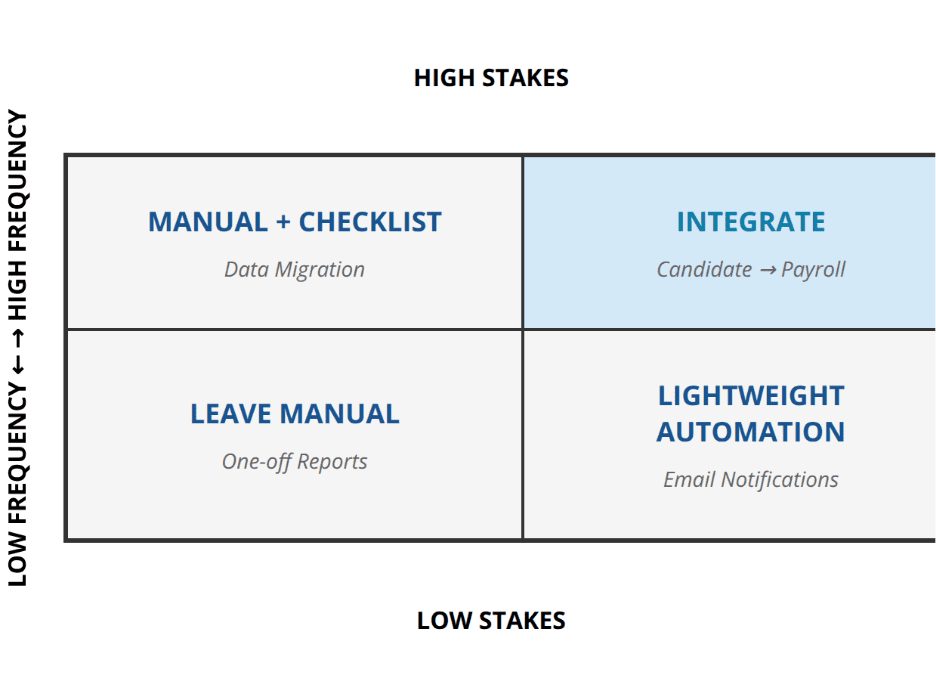
Effective staffing SaaS integration requires knowing which workflows justify the investment and which ones do not. Not every disconnected workflow justifies the cost of integration. Building APIs, maintaining data synchronization, and managing system dependencies require ongoing resources. The question is not whether you can integrate your systems but whether you should.
High-Frequency Workflows That Justify Integration Investment
Staffing SaaS integration delivers the clearest ROI when it eliminates manual steps from workflows your team repeats dozens of times each week. The same placement data gets referenced dozens of times across billing, compliance, and relationship management. Manual updates create bottlenecks that slow your entire operation.
High-frequency, high-stakes workflows demand integration. The upfront cost of building robust connections pays for itself within months when you eliminate hours of weekly manual work and reduce error rates that create downstream problems.
Low-Frequency Workflows Don’t Need Automated Solutions
Building integration for low-frequency workflows often costs more than the manual process it replaces. If you generate quarterly executive reports by pulling data from three systems, spending weeks engineering automated data flows makes little sense. A careful manual process with verification checklists delivers the same accuracy at a fraction of the cost.
Over-integration also creates brittleness. Every automated connection becomes a potential failure point requiring technical resources to maintain. When systems update, integrations break. When vendors change APIs, workflows stop working. Sometimes the most reliable process is the one that does not depend on perfect technical coordination.
Read More: How to Execute a Flawless CRM Migration in Your Staffing Firm
Common Integration Mistakes That Cause Operational Failure
Most costly staffing SaaS integration projects fail for organizational reasons, not technical ones. Your systems can talk to each other perfectly while your team still reverts to manual workarounds because of predictable mistakes during implementation.
Building APIs Before Defining Data Ownership and Workflow Protocols
Firms start with technical integration and retrofit process clarity later. They build connections between systems before answering which platform serves as source of truth for candidate status, who owns data updates when candidates move from submission to interview, or what triggers status changes across multiple platforms.
Mid-implementation, teams discover they disagree about workflow ownership, data definitions vary across departments, and no one mapped exception scenarios. Technical work stops while organizational questions get resolved, turning three-month projects into nine-month nightmares.
Treating Integration as Technical Work Without Organizational Change Management
Integration architecture requires data governance frameworks defining system hierarchies, workflow handoff protocols specifying who does what when, and change management processes that help teams adopt new workflows. You need someone mapping every touchpoint where information crosses system boundaries and designing fallback procedures for automated process failures.
This is why organizations waste over $1 million annually on SaaS tools that sit unused.2 The technical integration works, but the organizational layer that makes it functional never gets built.
Over-Engineering Integration for Low-Frequency Workflows
Every automated connection becomes a failure point requiring technical resources to maintain. When vendors update APIs or systems change, workflows break. You trade manual data entry for ongoing maintenance costs that compound as your tech stack grows.
Missing Warning Signs of Flawed Integration Design
Your team builds workarounds to avoid using integrated systems. Data conflicts happen regularly because no one defined which system wins. Integration projects take months longer than planned because process questions surface mid-build. These signals mean your integration strategy needs architectural expertise, not more technical fixes.
Let Newbury Partners Help Your Tools Work Together
Staffing SaaS integration projects fail when firms build automated connections for workflows that do not justify the ongoing maintenance cost. It is about connecting the right ones in the right order with the right process layer underneath.
Newbury Partners helps growth-focused staffing firms build integration architecture that balances connectivity with operational clarity. We design the process layer that makes technical integration actually work, so your systems support scale instead of creating friction. Ready to turn your fragmented tech stack into a competitive advantage? Contact us today.
References
1. Zielinski, Dave. “Simplify Your Tech Stack: The Risks and Redundancies of HR Software Sprawl.” SHRM, 18 Apr. 2025, https://www.shrm.org/executive-network/insights/simplify-tech-stack-risk-redundancies-hr-software-sprawl.
2. Pavithran, Apu. “Why Your Business Should Simplify and Consolidate Its Tech Stack.” Entrepreneur, edited by Micah Zimmerman, 3 Dec. 2024, https://www.entrepreneur.com/leadership/why-cutting-tech-complexity-could-be-your-smartest-business/482463.