

Opening your third location should multiply your capacity. Instead, it often multiplies your headaches. Branch managers interpret processes differently, top performers in one office can’t share candidates with another, and you discover client service quality varies wildly depending on which location handles the relationship.
The operational complexity that comes with geographic expansion can undermine the growth you worked so hard to achieve.
Multi-location staffing firms face coordination challenges that don’t exist in single-office operations. What worked when everyone sat in the same room breaks down across cities and time zones. Scaling staffing firm operations successfully requires more than opening new offices; it demands operational frameworks that maintain consistency without sacrificing the local adaptation that makes each branch effective.
The Multi-Location Breaking Points: Where Coordination Falls Apart
As staffing firms expand beyond two locations, specific operational friction points emerge that single-office optimization never addresses.
- Process divergence creates inconsistent client experiences. Each branch develops its own interpretation of standard workflows – different screening criteria, varied timelines, inconsistent follow-up. Clients working with multiple locations experience your brand differently depending on which office handles their requisitions.
- Communication silos trap knowledge and candidates locally. Your Denver office has perfect candidates for roles Atlanta struggles to fill, but neither knows the other exists. Research shows that ineffective communication results in 7.47 hours of lost productivity per employee weekly.1 For a multi-location staffing firm with 100 employees, that translates to $1.25 million in annual losses from coordination breakdowns alone.
- Uneven performance across locations defies easy diagnosis. One office consistently exceeds targets while another struggles, yet surface metrics don’t reveal why the gap exists – market conditions, management effectiveness, process adherence, or resource allocation.
- Leadership capacity constraints create operational blind spots. Without systematic visibility into branch operations, problems compound undetected until quarterly reviews surface them. Local managers lack clear frameworks for independent decisions versus escalation requirements, creating bottlenecks across all locations.
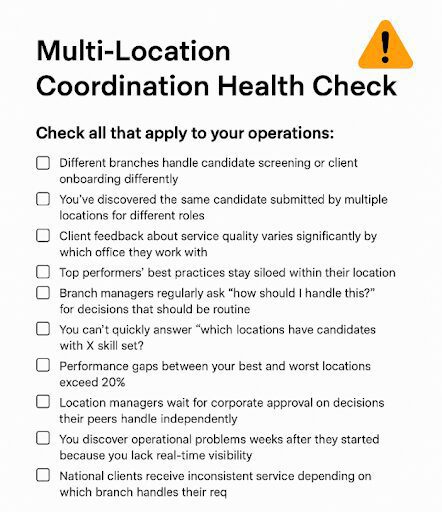
What this reveals:
- 1-3 boxes checked: You have isolated coordination issues that targeted process documentation can address
- 4-6 boxes checked: Systematic coordination gaps require operational framework implementation across locations
- 7+ boxes checked: Fundamental infrastructure missing – need comprehensive standardization, visibility systems, and leadership frameworks before further expansion
Read More: Building a Change-Ready Organization: The Importance of a Clear Strategy
The Three Pillars of Scalable Multi-Location Operations
Sustainable multi-location growth requires operational infrastructure that creates consistency where it matters while preserving local flexibility.
Standardize Core Processes (Without Killing Autonomy)
Distinguish between non-negotiables and areas where local adaptation improves results. Client onboarding, candidate submission protocols, and compliance documentation must remain consistent – these impact brand perception and legal risk. Local sourcing strategies, relationship styles, and market-specific outreach can flex based on regional dynamics.
Document core workflows with explicit decision points showing where consistency is required versus where managers have discretion. This clarity prevents branches from reinventing standard processes while confidently customizing approaches that benefit from local knowledge.
Build Tech-Enabled Visibility Across Locations
Leadership cannot manage what it cannot see. Centralized dashboards showing real-time performance metrics, shared candidate databases revealing talent across locations, and automated alerts for process deviations create the transparency multi-location coordination requires.
When your Dallas team instantly sees Denver’s matching candidates, coordination happens naturally. When dashboards surface one location’s diverging metrics, investigation and correction happen proactively rather than during quarterly reviews.
Empower Location Leaders with Decision-Making Frameworks
Research shows that 45 percent of organizations struggle with trust and control issues in delegation, while 40 percent cite lack of clear communication as major roadblocks.2 Without frameworks, location managers either bottleneck decisions or make inconsistent choices undermining standardization.
Define what location managers decide independently: hiring within approved parameters, client pricing within ranges, local marketing spend up to limits, operational issues following protocols. Escalation criteria should be equally clear: pricing exceptions, process changes, capital expenditures above thresholds, situations without precedent.
Organizations engaging senior leadership in governance report 75 percent effectiveness versus 59 percent without involvement.3
Making It Stick: Implementation Without Disruption
Rolling out operational frameworks across established locations requires careful sequencing to build adoption rather than trigger resistance.
- Start with your best-performing location as the pilot. Use your strongest branch to document what’s working, then standardize those practices across other locations. This approach builds credibility – you’re not imposing untested theory but scaling proven success.
- Implement standardization incrementally, not simultaneously. Roll out one core process at a time: candidate submission protocols first, then client onboarding, then reporting cadences. Attempting wholesale operational overhaul across multiple locations creates chaos and undermines the consistency you’re trying to build.
- Build feedback loops that give location managers input. Standardization fails when imposed top-down without local context. Create regular forums where branch leaders surface what’s working, what needs adjustment, and where local market conditions require flexibility within your frameworks.
- Establish cross-location knowledge sharing mechanisms. What’s driving Denver’s placement velocity? How did Atlanta solve their candidate drop-off problem? Systematic sharing prevents each location from solving the same problems independently while building collaborative culture across your branch network.
- Use technology to enable frameworks, not replace management. Dashboards and shared systems make consistency visible and coordination possible, but they don’t substitute for strong location leadership. Invest equally in management development and technical infrastructure.
Read More: How to Build a High Performing Middle Office
Scale Your Operations with Confidence
Multi-location growth requires more than adding offices – it demands operational infrastructure that maintains consistency without stifling local effectiveness. Newbury Partners helps staffing firms build the technology platforms and operational frameworks that enable scalable multi-location coordination.
We design centralized visibility systems, standardized process documentation, and delegation frameworks that empower location leaders while maintaining brand consistency. Contact us today to build a multi-location staffing strategy that scales without stress.
References
1. Heath, Robert, Sr. “The True Price of Poor Communication: Unveiling Hidden Costs.” LinkedIn, 4 Jan. 2025, https://www.linkedin.com/pulse/true-price-poor-communication-unveiling-hidden-costs-heath-sr–e1ysc/.
2., 3. Pruetz, Kelly. “Delegation of Authority: Key Insights for Effective Decision-Making.” APQC, 25 Mar. 2025, https://www.apqc.org/blog/delegation-authority-key-insights-effective-decision-making.