

Say your commissions rollout went live on schedule. Recruiters are getting paid, and ops closed the project. Then the month-end arrives, and finance pulls the numbers. Something does not add up, not because the system malfunctioned, but because the logic does not reflect how finance needs to account for those payments.
Accrual timing is off, and edge cases that seemed minor are now producing numbers that finance cannot defend. This is not a technology failure. It is an ownership problem.
When commissions automation is designed without finance at the table, the system inherits whatever assumptions were made in their absence. By the time finance sees the output, the rules are already live and harder to fix. Finance co-ownership is not an approval step at the end. It is a design requirement from the beginning.
Why Finance Teams Are Often at a Disadvantage Before a Rollout Starts
When finance joins a commissions rollout after the design phase, they inherit a system built around operational assumptions they never validated.
Finance Spends More Time Pulling Data Than Analyzing It
Finance teams spend 50 percent of their time during month-end close pulling data from disintegrated systems rather than analyzing what the numbers mean.1 When commissions automation is designed without finance input, it often adds another source to reconcile rather than eliminating manual work.
The system calculates commissions accurately based on the rules it was given, but those rules were never translated into the language finance needs for close. Finance ends up building its own bridge between operational outputs and accounting requirements.
Ops Thinks in Recruiter Relationships; Finance Thinks in Payment Liabilities
Operations teams design commission logic around what recruiters expect to see and when they expect to see it. Finance designs around when a payment becomes a liability and how it flows through accounting periods. Neither is wrong, but when only one side designs the workflow, the other inherits the gaps.
A commission that ops considers earned when a placement starts might not become a payable liability in finance’s view until the candidate completes their first week or the client approves the invoice.
When Finance Is Not Involved Early, They Cannot Course-Correct Later
By the time finance flags a problem, the logic is already live, and recruiters are seeing outputs based on it. Rebuilding rules post-launch is significantly more disruptive than resolving the disagreement during design.
Recruiters have already been paid under one set of assumptions, so changing the logic retroactively creates disputes and forces finance to reconcile two different calculation methods simultaneously. Early alignment prevents this entirely.
What Finance Co-Ownership Changes About the Build
When finance co-designs commission logic from the start, the system gets built to serve both operational clarity and financial accuracy without requiring reconciliation between the two.
Commission Triggers and Accrual Timing Require Finance Input to Get Built Correctly
Several decision points in commission design require a finance perspective to avoid downstream problems. When does a commission become a payable liability: at placement start, after the first week worked, or when the client approves the invoice? How are partial placements handled if a candidate leaves before completing their assignment?
What accrual timing applies across different deal types, such as contract placements versus direct hires? Operations teams answer these questions based on recruiter expectations. Finance answers them based on accounting standards and cash flow management. When both sides align on the answers during design, the system executes logic that satisfies both requirements without creating disputes at close.
Cross-Functional Design Drives Higher Technology Adoption
Organizations using cross-functional teams experienced 34 percent higher technology adoption than siloed counterparts.2 When finance co-owns the commission logic, they can explain every number at close because they helped define how it was calculated.
Recruiters trust the outputs because ops validated that the rules reflect how they actually work. Month-end close becomes a confirmation rather than a reconciliation. Disputes drop because the rules were never in question, and both teams are working from the same source of truth.
Check Where Your Rollout Stands on Finance Alignment
Not every commissions implementation has a finance alignment gap, but most firms do not find out until the month-end close surfaces the problem. The diagnostic below walks through four questions about how your commission logic was built and who owns it today. Depending on where you land, it will tell you whether your rollout is built on co-designed logic or inherited assumptions.
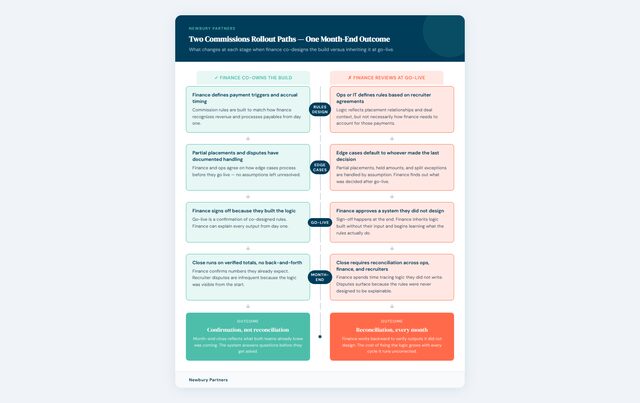
Month-End Close Becomes a Confirmation, not a Reconciliation
When finance is absent from the design phase, close becomes an investigation. Finance pulls commission totals, cross-references them against placement records, identifies discrepancies, and investigates why the numbers do not match expectations. When finance co-designs the logic, close becomes verification.
The system calculated commissions based on rules that finance approved, so the numbers align with what accounting expects. Finance reviews for accuracy, confirms accruals match the liability schedule, and moves forward. The time saved compounds every month because the reconciliation work never needs to happen in the first place.
Build Commissions Systems Finance Can Actually Stand Behind
Commission automation works when finance and ops co-own the outcome from the start. Newbury Partners bridges how ops thinks about commissions and how finance needs them to work, aligning both sides before anything gets built.
Whether you are planning a new rollout or fixing a system that never quite delivered what finance needed, we help you build commission logic that both teams can stand behind. Contact us to start an assessment.
References
1. “Beyond the Close: Turning Financial Data into Real-Time Strategic Insights.” The CFO, 17 Feb. 2026, the-cfo.io/2026/02/17/beyond-the-close-turning-financial-data-into-real-time-strategic-insights/.
2. “How Cross-Functional Teams Rewrite the Rules of IT Collaboration.” CIO, 6 Oct. 2025, www.cio.com/article/4065346/how-cross-functional-teams-rewrite-the-rules-of-it-collaboration.html.