

Your BI dashboard is running. Placement volumes, recruiter activity, revenue by division; the numbers are there. But by the time a risk shows up in a report, it has usually already cost something. A placement that fell through.
A recruiter whose output quietly dropped. A commission figure that did not reconcile until after payroll ran. The signal was in the data the whole time. It just was not visible until the damage was done.
That is not a reporting failure. It is a visibility timing problem. Most staffing BI is configured to confirm what already happened, not to surface what needs attention right now. The question is not whether you have the data. It is whether your BI is configured to show it in time to act.
Why Your Dashboard Shows You What Already Happened
Most staffing leaders are not working with bad data. BI risk signals staffing operations depend on are being generated right now. The problem is that most configurations are not built to show them in time to act. They are working with delayed data, and in a fast-moving operation, that delay is where risk lives.
Lagging indicators confirm problems after the fact.
Monthly reports tell you a placement stalled after the billing cycle closed. They tell you a recruiter’s output dropped after it affected the team’s numbers. By the time those signals appear in a standard report, the operational cost is already in motion. The report is not wrong. It is just arriving after the window to prevent the problem has already closed. BI risk signals staffing leaders actually need are present-tense, not confirmations of what the last billing cycle already absorbed.
The gap between a problem forming and appearing in a report is where revenue leaks.
80 percent of organizations still rely on stale data for decision-making, and 85 percent of data leaders admit that acting on outdated data has directly cost their organizations money.1 Staffing operations are not exempt from that dynamic.
The lag between when a risk forms and when it surfaces in reporting is not a data quality problem. It is a visibility timing problem. And in a business where billing cycles, client commitments, and recruiter capacity all move on short timelines, that lag has a direct operational cost.
The instinct to pull more reports does not close the gap.
Adding more dashboards or running reports more frequently does not solve the underlying issue if those reports are still built around lagging indicators. More output from the same configuration produces more confirmation of what already happened.
The question is whether the data is configured to show you what needs attention now rather than what went wrong last month.
What the Gap Between Lagging and Leading Looks Like in Practice
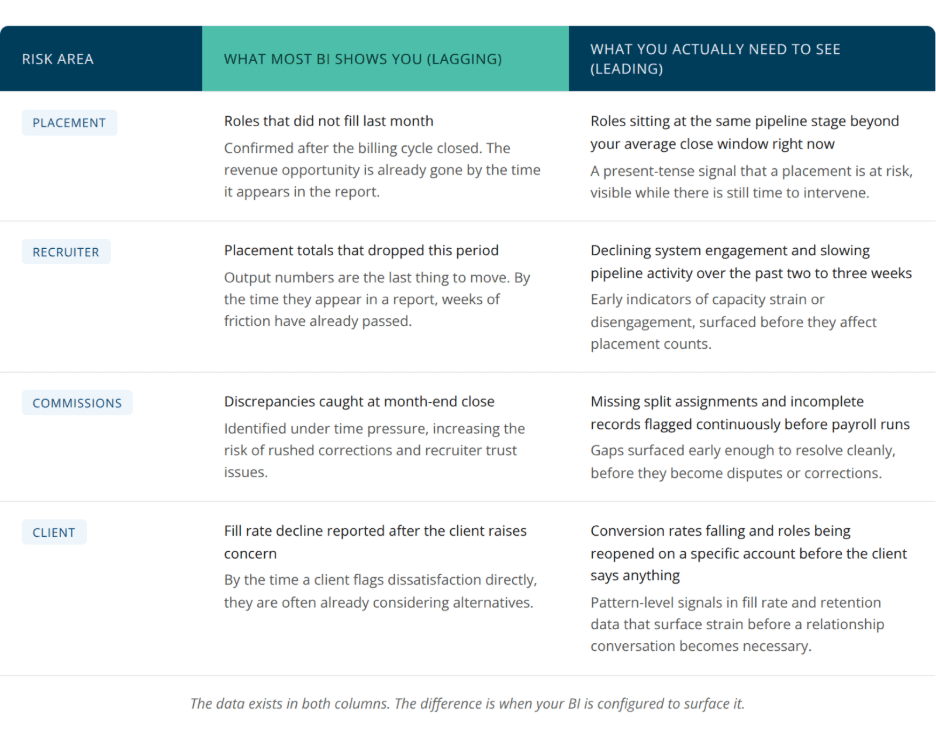
BI risk signals staffing firms rely on fall into predictable categories once you map them against the risks that matter most operationally. Mapped against the risks that matter most in a staffing operation, it looks like this.
The Signals That Tell You Something Needs Attention Now
BI risk signals staffing leaders can act on share one quality: they appear in current data before the operational cost is already in motion.
Placement risk shows up before a job falls through.
A role that has sat at the same pipeline stage longer than your average close window. A submission rate that has slowed on a specific desk without a corresponding drop in job orders. These are present-tense signals, visible in current data, that indicate a placement is at risk before it is lost. By the time that role appears as a failure in a monthly fill rate report, the revenue associated with it is already gone.
Recruiter performance drift appears before output numbers drop.
Declining system engagement, slower candidate response times, and reduced pipeline activity are early indicators that a recruiter is approaching capacity or disengaging. By the time those patterns show up in placement totals, weeks of compounding friction have already passed.
The output number is the last thing to move. Everything leading up to it is visible in current activity data well before the placement count reflects it.
Commission data gaps surface before payroll runs.
By then, the window for a clean resolution is narrow, and the pressure to move fast increases the risk of error. BI configured to flag those gaps continuously gives finance teams time to resolve them before they become disputes, corrections, or recruiter trust issues.
Client relationship strain shows up in fill rate patterns before a client says anything.
Some of the most overlooked BI risk signals staffing account managers should track are embedded in fill rate and retention data, not client conversations. Submission volumes that are high, but conversion rates quietly falling.
Clients rarely flag dissatisfaction directly until they are already considering alternatives. The pattern shows up in fill rate and retention data first, well before a relationship conversation becomes necessary.
Your BI Should Be Telling You More Than It Is
BI risk signals staffing operations need are already in your system. The question is whether your configuration is built to surface them before the damage compounds. If your dashboards are confirming what happened last month rather than surfacing what needs attention this week, that is not a data problem. It is a configuration problem. The signals are already in your system. The question is whether your BI is set up to show them at the right time.
Newbury Partners builds BI around operational risk and early detection, not just reporting. If your current dashboards are telling you what happened rather than what needs attention, that gap is closeable. The data you already have is further along than it appears. It just needs to be configured to work for you in real time. Talk to us today.
Reference
1. Sinha, Chandni. “Seconds Matter: The Real Cost of Delayed Data in an Always-On World.” IBM, www.ibm.com/think/insights/delayed-data-cost.