

If you’re following the AI momentum, your firm is probably past the “should we automate?” question and into the messier reality of managing what you’ve already implemented. The challenge is now knowing which initiatives are worth the continued investment.
Most organizations achieve satisfactory ROI on AI initiatives within two to four years, with only 6 percent seeing returns in under a year.1 Without clear performance metrics, you can’t tell if your automation is on track to deliver or quietly wasting resources. Here’s how to build that evaluation discipline into your automation strategy and ensure staffing automation ROI.
When Staffing Automation Doesn’t Deliver
Not all automation pays off. Here’s what to watch for:
- Quality drops: Candidate complaints increase, placement errors multiply, or data accuracy deteriorates beyond what you saw with manual processes.
- Team workarounds: Recruiters bypass the automation entirely, creating shadow processes that defeat the purpose. If your team is routing around the tool, it’s not solving their actual problems.
- Resource drain: Your team spends more time managing, troubleshooting, or correcting the automation than it saves. If it takes more effort to maintain than it eliminates, it’s not working.
- Compliance gaps: Automated workflows miss regulatory requirements or fail to adapt when rules change, creating risk exposure your manual processes didn’t have.
- Low adoption: Usage metrics show recruiters avoiding the tool after the initial rollout. High abandonment rates signal that the automation doesn’t fit your actual workflows.
These signals you’re investing in automation that’s actively hurting performance. The key is knowing what to measure so you catch these issues before they compound.
The Real Staffing Automation ROI Metrics That Matter
Time saved isn’t the only thing to measure. Recent research shows that 90 percent of workers report increased productivity from automation solutions, 89 percent trust these tools to reduce errors, and nearly 90 percent report higher job satisfaction since implementation.2
But getting to those outcomes requires tracking performance across multiple dimensions, not just counting hours saved.
Type image caption (optional)
Speed & Efficiency Metrics
Start here because time savings are the most obvious ROI indicator. But speed alone doesn’t tell the full story; measure whether faster processes are maintaining quality or just creating rushed outcomes that hurt placement rates.
Accuracy & Quality Metrics
Automation should reduce errors, not multiply them. If your resume parsing creates more cleanup work than it saves, or your automated candidate communications are triggering complaints, the speed gains become meaningless.
Adoption & Usability Metrics
The best automation fails if your team won’t use it. Track user engagement rates, how often recruiters bypass the automation to do things manually, and support ticket volume. High bypass rates signal that the automation doesn’t fit your actual workflows, while increasing support tickets suggest the tool is creating friction rather than eliminating it.
Business Impact Metrics
Ultimately, automation should improve business outcomes, not just operational efficiency. These metrics connect automation performance to actual profitability and help you understand whether efficiency gains are translating to revenue growth.
How to Decide: Kill, Optimize, or Scale
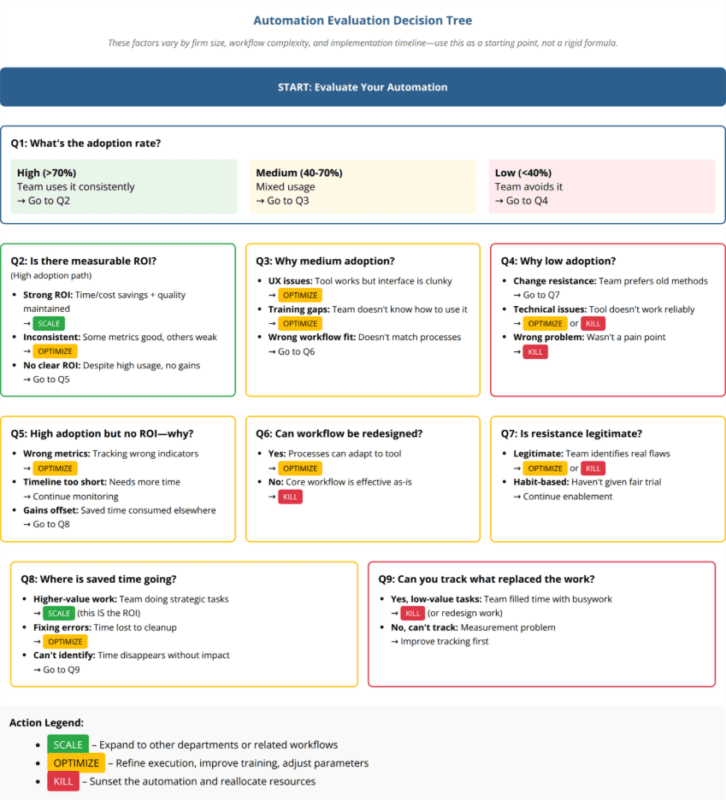
Measuring automation performance is pointless if you don’t act on what you learn. Once you’ve tracked metrics across speed, accuracy, adoption, and impact, you need a framework for deciding what to do next. Not every underperforming automation deserves more investment, and not every successful one is ready to scale.
Kill It
Some automations fail because they were solving the wrong problem or weren’t suited for automation in the first place. If you’re seeing low adoption, high resource drain, and no measurable impact after optimization attempts, sunset the automation.
This isn’t admitting defeat but reallocating resources toward workflows that actually deliver returns. The sunk cost fallacy keeps many firms investing in automations that will never pay off, when that budget could fund initiatives with clearer ROI potential.
Optimize It
High adoption but inconsistent results signals that the core concept works but the execution needs refinement. This might mean adjusting workflow parameters, improving data quality feeding into the automation, retraining AI models with better examples, or redesigning how the automation integrates with your existing processes.
Look for patterns in when the automation performs well versus when it fails, those patterns reveal what needs fixing.
Scale It
When you see high adoption, measurable ROI, and consistent performance across the metrics that matter, that’s your signal to expand. Smart scaling doesn’t mean rolling out everywhere at once.
It means identifying similar workflows in other departments, automating related processes that share the same data infrastructure, or investing in advanced capabilities that build on what’s already working. The key is scaling proven concepts, not replicating experiments.
When to Reassess Your Automation Portfolio
Automation performance isn’t static. Here are the triggers that signal it’s time to re-evaluate.
- Performance degradation: Metrics that were strong at launch start declining; error rates increase, adoption drops, or speed gains disappear as data volume grows.
- New AI capabilities available: Tools have improved significantly since your initial implementation, making previously complex automations more feasible or cost-effective.
- Process changes: Your workflows have evolved but the automation hasn’t kept pace, creating misalignment between how the tool works and how your team actually operates.
- Consistent team feedback: Recruiters report ongoing frustrations, workarounds become standard practice, or support requests reveal the same issues repeatedly.
- Business model shifts: Changes in your service offerings, client mix, or compliance requirements mean the original automation no longer serves your current needs.
Build an Automation Strategy That Delivers Real Returns with Newbury Partners
Automation isn’t “set it and forget it.” Without ongoing measurement and strategic reallocation, you can’t tell which initiatives are delivering returns and which ones are quietly draining resources. Newbury Partners helps staffing firms evaluate automation performance, optimize underperforming workflows, and build tech stacks that actually deliver measurable staffing automation ROI.
Let’s turn your automation investments into proven results.
References
1. Horton, Richard, Jan Michalski, Stacey Winters, Douglas Gunn, and Jennifer Holland. “AI ROI: The Paradox of Rising Investment and Elusive Returns.” Deloitte, 22 Oct. 2025, https://www.deloitte.com/nl/en/issues/generative-ai/ai-roi-the-paradox-of-rising-investment-and-elusive-returns.html.
2. “How Automation Drives Business Growth and Efficiency.” Harvard Business Review, 12 Apr. 2023, https://hbr.org/sponsored/2023/04/how-automation-drives-business-growth-and-efficiency.