

You already have a number. A cost of inaction staffing analysis asks a different question than a cost comparison, and that distinction is usually what determines whether the evaluation reaches a yes.
Someone walked you through what a Navigator engagement would cost, you compared it against what you are currently spending, and the evaluation stalled anyway. Nothing about the pitch was dishonest, and the number itself was not unreasonable. Something about the comparison just did not add up to a yes.
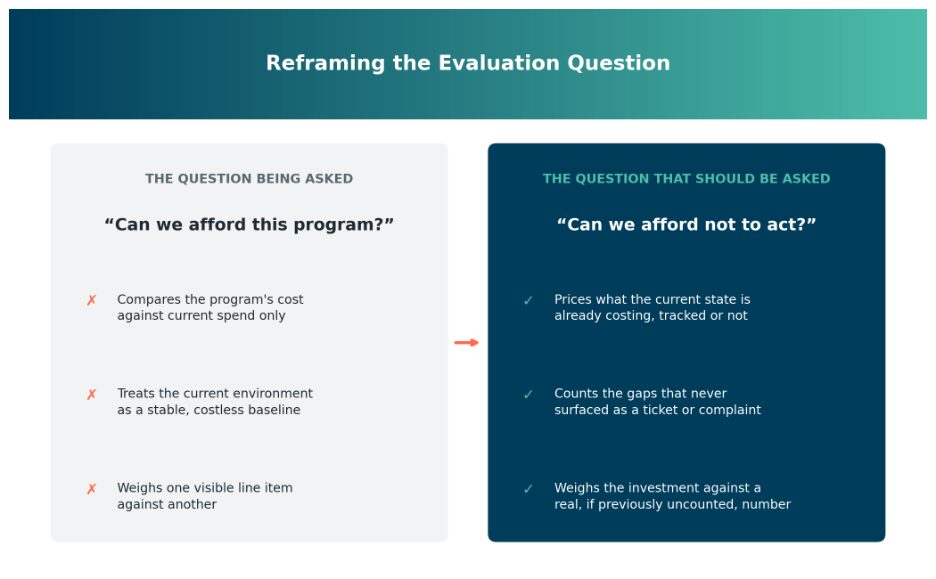
That is usually not a sign the number is wrong. It is a sign the number was answering the wrong question. Your evaluation asked what the program costs. It did not ask what the current state is already costing you, which is a different question with a different answer.
Why the Deal Stalls at the Same Point Every Time
The cost of inaction staffing reframe reveals why the stall is not hesitation. It is a predictable outcome of how the evaluation was structured from the start.
A Cost Comparison Treats the Current State as Free
A cost comparison puts two numbers side by side: what the program costs, and what you are currently spending. That framing quietly assumes your current state carries no cost of its own, as if the status quo were a neutral baseline instead of an active choice with consequences. It is not. A cost of inaction staffing analysis corrects that assumption by attaching a number to the current state before anyone compares it to the program cost.
Can We Afford This” Is the Wrong Question, Not Just a Hard One
This is not simply a difficult question to answer. It is the wrong question to be asking in the first place. For instance, of B2B deals that end in no decision rather than closing, 44 percent come down to genuine status quo preference, the buyer deciding the current state is safer than changing.1
A cost of inaction staffing analysis is what prices the state that was never priced, so the evaluation is no longer comparing a known cost against an assumed zero.
Why the Cost of Inaction Is Actually Measurable
A cost of inaction staffing analysis is not a persuasive reframe. It is a real number built from what your current Bullhorn environment is already producing and already costing.
Most Managed Services Wait for Something to Break
This is the assumption sitting underneath the stalled evaluation, even when nobody states it directly. Most managed services models are reactive by design. A ticket gets submitted, a workflow breaks, someone calls for help, and the service responds.
That model is exactly why a simple cost comparison feels adequate. That reactive model is why a simple cost comparison feels like a complete question, and why a cost of inaction staffing analysis changes what the evaluation is actually measuring.
A Gap Never Gets the Chance to Become a Ticket
A proactive model works differently. It does not wait for a problem to surface on its own. It looks for what is drifting before anyone has a reason to report it, which means the gaps it catches are ones that would have stayed invisible under a reactive model, not because they were minor, but because nothing forced them into view.
A cost of inaction staffing analysis captures the cost of those invisible gaps, because invisible is not the same as zero and a workflow running at half efficiency still has a price.
The Current State Has a Number Too: It’s Just Never Been Calculated
The cost of inaction staffing analysis starts from one premise: the gaps inside your current Bullhorn environment are accumulating cost whether or not anyone is tracking them. The same way any unmeasured process still produces a result.
The reason your evaluation never weighed this number is not that it does not exist. It is that nobody had gone looking for it yet, which is a different problem than the number being small or negligible.
Once Quantified, the Gap Is Usually Larger Than the Investment
In Newbury Partners’ experience running a cost of inaction staffing analysis with finance leaders, the quantified gap consistently comes in larger than the managed services investment required to close it. This is not a projection or an industry benchmark.
It is a pattern observed across engagements, and it is the reason the reframe changes the outcome of the evaluation rather than just the wording of the question. Once finance leaders see that number next to the investment side by side, the comparison that stalled the deal in the first place tends to resolve itself.

Talk to Newbury Partners About Getting Your Number
cost of inaction staffing analysis only changes the outcome of the evaluation once there is an actual figure behind it, built from your own Bullhorn environment rather than a general industry estimate. Talk to Newbury Partners about Navigator and get a cost-of-inaction analysis built for your specific Bullhorn environment, not a general estimate, but a number calculated against what your own current state is actually costing you.
Reference
1. Dixon, Matthew, and Ted McKenna. The JOLT Effect: How High Performers Overcome Customer Indecision. Portfolio/Penguin, 2022.