

Your recruiting team ran a successful AI pilot that improved resume screening efficiency. Leadership celebrated the proof of concept at the quarterly all-hands meeting. Six months later, that same pilot remains isolated in a single department while the rest of the organization continues with manual workflows.
This pattern appears frequently across firms experimenting with AI. The obstacle is rarely technical capability. Successful AI leadership staffing initiatives reveal organizational challenges that leaders did not anticipate: competing departmental priorities, unclear budget ownership, middle management hesitation, and the absence of structured decision-making frameworks.
The Post-Pilot Leadership Trap: When Success Creates New Problems
SuSuccessful AI pilots create momentum, but that momentum often exposes organizational fault lines invisible during small-scale testing. AI leadership staffing challenges emerge when firms try to scale beyond controlled experiments:
- Executive Overconfidence Meets Board Pressure for ROI: Leadership celebrates pilot results, then boards demand immediate enterprise-wide returns. Executives find themselves caught between demonstrating progress and acknowledging that systematic rollout requires more time and resources than the pilot phase suggested.
- Competing Departmental Priorities Fragment AI Strategy: Sales wants lead generation automation, operations pushes for compliance tracking, recruiting advocates for candidate screening. Without clear prioritization frameworks, these competing interests create analysis paralysis rather than coordinated action.
- Budget Reallocation Battles Replace Decision-Making: Who funds enterprise rollout; IT budget, department budgets, or new capital requests? Successful pilots rarely include comprehensive cost projections for organization-wide implementation. When finance demands answers about licensing, integration, and training costs, finger-pointing replaces planning. Effective AI leadership staffing requires addressing these budget questions during pilot design, not after proving technical feasibility.
- Pilot Fatigue Burns Out Early Adopters: Your most enthusiastic users provided feedback and refined workflows during testing. Months later, they watch tools remain in perpetual pilot status while being asked to test yet another solution. This pattern transforms champions into skeptics.
Read More: Scaling AI in Staffing: From Pilot Wins to Enterprise Value
The Hidden Resistance: Why Middle Management Quietly Blocks AI Leadership Staffing Adoption
Executives champion AI publicly. Front-line employees express cautious optimism. But middle managers often become silent blockers of AI leadership staffing initiatives. This resistance rarely shows up as direct opposition. Instead, it looks like endless caution, constant feature requests, or workflow concerns that never get resolved.
Read More: From Pilot to Enterprise: Scaling Staffing Tech Initiatives with Confidence
Middle Management Faces Real Job Security Threats
The anxiety is grounded in reality. Gartner forecasts that by 2026, 20 percent of companies will use AI to flatten their structures, cutting more than half of middle management roles. Deloitte found 42 percent fewer middle management job postings in late 2024 compared to spring 2022.1 When AI threatens the coordination work that makes middle managers valuable, resistance becomes survival.
Blocking Behavior Disguises Itself as Diligence
Resistance looks reasonable on the surface: feature requests that delay rollout, manual reviews that cancel out automation benefits, endless assessments that keep tools in testing mode. Supporting multiple competing solutions fragments your strategy while looking like careful vendor evaluation.
Legitimate Concerns Look Different from Self-Preservation
Not all pushback is blocking. The difference shows in behavior. Engaged managers bring specific fixes and timelines, identify where AI fits, volunteer for pilots, and help improve processes. Blockers criticize without offering solutions, explain why nothing will work, and avoid setting clear criteria that would let projects move forward.
Governance Participation Converts Skeptics into Champions
The most effective approach gives middle managers real roles in AI governance. Seat them on committees with actual decision power. Let them define success metrics for their teams instead of imposing requirements from above.
Include them in vendor reviews where their operational knowledge adds value. When middle managers own implementation decisions, their career success connects to AI outcomes instead of getting threatened by them. This organizational alignment is critical to effective AI leadership staffing at scale.
Building an AI Governance Committee That Actually Decides Things
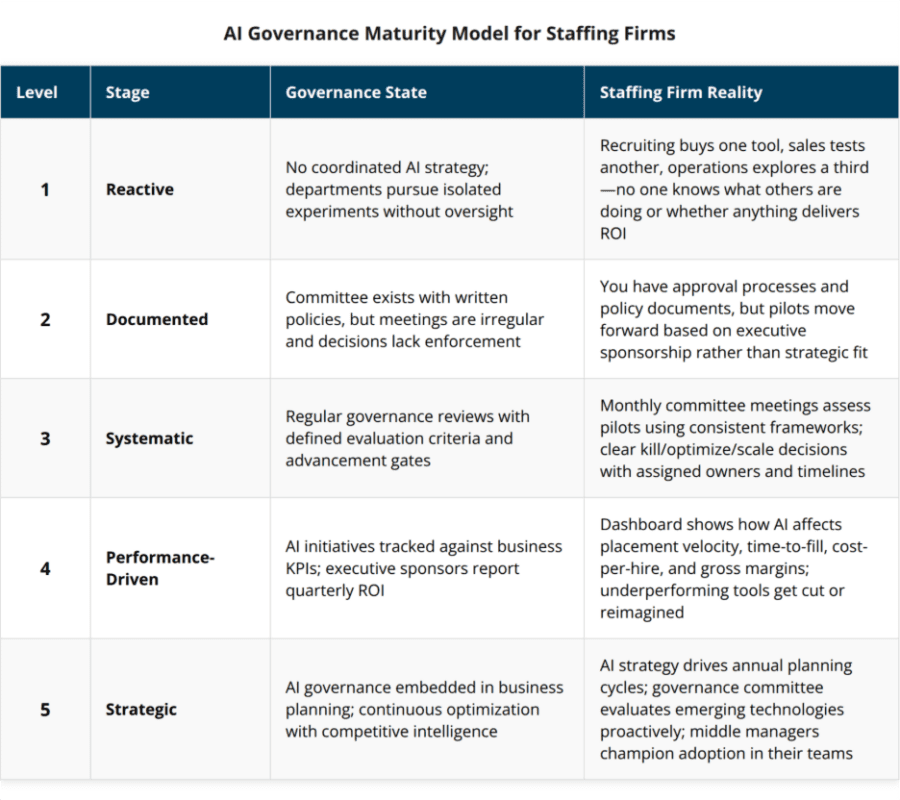
Research shows that 70 percent of change management efforts fail, often because leaders focus on process mechanics while ignoring organizational readiness.2 Moving up the maturity curve requires a structured approach to AI leadership staffing governance
Read More: AI Enablement for Staffing Firms: How to Tell If Your Firm Is Truly Ready to Automate
Cross-Functional Representation Prevents Blind Spots
Governance committees fail when they consist only of technical staff who understand systems but miss business context. Effective committees include operations leaders who bring workflow reality, finance reps who validate ROI, sales and recruiting leads who offer adoption insights, and legal counsel who manages compliance.
This structure ensures AI leadership staffing decisions account for technical capability, business impact, user experience, financial viability, and regulatory requirements simultaneously.
Clear Decision Criteria Replace Politics with Process
Without explicit standards, pilot assessments become political negotiations where the loudest voices win. Establish concrete criteria: integration complexity, training requirements, measurable business impact, and resource availability.
Create advancement stages with defined thresholds, proof-of-concept demonstrates technical feasibility, departmental pilot validates workflow integration, enterprise deployment proves ROI at scale. Pilots advance only when they meet criteria at each gate.
Monthly Kill/Optimize/Scale Reviews Prevent Resource Waste
Quarterly meetings cannot maintain momentum or catch problems early. Monthly reviews create the accountability necessary for effective AI leadership staffing. Green-light pilots that meet all criteria and allocate resources immediately.
Optimize initiatives that show promise but need specific fixes, with clear owners and deadlines. Kill projects that cannot demonstrate ROI, freeing resources for better prospects. Refusing to kill underperforming pilots wastes budget that could fund solutions with actual potential.
Executive Sponsorship Creates Accountability Without Bureaucracy
Governance without executive accountability becomes a bureaucratic bottleneck. AI leadership staffing requires specific executives to own outcomes, not committees making recommendations nobody implements. Assign executive sponsors to each major initiative, making specific leaders responsible for outcomes.
Require quarterly ROI reviews where sponsors present measurable business impact to justify continued investment.
Decision Timelines Prevent Analysis Paralysis
Employees now experience ten planned changes per year, five times more than a decade ago.3 This change fatigue demands faster decisions. Give pilots 90 days maximum for departmental testing, then make a definitive kill, optimize, or scale decision.
Organizations with structured approaches reach 70 to 80 percent success rates versus 70 percent failure for ad hoc methods.4 Speed matters, but structure determines outcomes. AI leadership staffing initiatives fail when firms move slowly through unstructured processes or rush through implementation without addressing organizational readiness.
Join Executives Who Scale AI Leadership Staffing Without the Chaos
Scaling AI requires navigating organizational politics, budget battles, and middle management anxiety, not just installing software. Newbury’s AI Collective equips executives with governance frameworks, change management strategies, and peer learning from leaders facing identical challenges.
Stop reacting to AI pressure and start building the strategic foundation that creates lasting competitive advantage. Contact us today.
References
1. “Why Middle Managers Are Making a Comeback.” CJPI, 27 Sept. 2025, www.cjpi.com/insights/why-middle-managers-are-making-a-comeback/.
2. Simpson, Cicely. “Why Change Management Fails: It’s About People, Not Process.” Forbes, Forbes Books, 6 May 2025, www.forbes.com/sites/forbesbooksauthors/2025/05/06/why-change-management-fails-its-about-people-not-process/.
3., 4. “Change Is Changing: How to Meet the Challenge of Radical Reinvention.” McKinsey & Company, 19 Nov. 2025, www.mckinsey.com/capabilities/people-and-organizational-performance/our-insights/change-is-changing-how-to-meet-the-challenge-of-radical-reinvention.