

How much of your Bullhorn analytics data actually makes it into your weekly decisions? If the answer requires a moment of thought, that is worth paying attention to. Bullhorn analytics captures recruiter activity, pipeline movement, and performance trends continuously, but if your reports are the same ones configured at go-live, you may be working with less visibility than the system can give you.
When data does not surface answers fast enough, workarounds fill the gap: manual exports, separate trackers, month-end reconciliations that take longer than they should. The cost is not always obvious. Here is what you might be leaving on the table inside Bullhorn, and which reports are worth actually building.
What Ops Teams Miss When Bullhorn Analytics Goes Underused
The gap between what Bullhorn analytics can surface and what your firm reviews creates blind spots that show up at the worst possible moment.
Recruiter Activity Stays Invisible Until It Is Too Late
Submission rates, call activity, and pipeline progression are all trackable inside Bullhorn analytics, but without consistent reporting, they rarely get reviewed until performance is already suffering.
By the time a pattern becomes visible in a quarterly review, the placement opportunities tied to that period have already passed. Managing recruiter performance without this data means managing by instinct rather than by what the system is already capturing.
Context-Switching Fills the Gap That Reporting Should Close
When Bullhorn does not surface answers quickly enough, the workaround is usually another tool: a spreadsheet, a shared tracker, a manually updated pipeline doc. That fragmentation carries a real cost. Context-switching between digital tools hampers productivity for 45% of workers, and for 44%, working across siloed tools makes it difficult to gauge whether work is being duplicated.1
In recruiting, that duplication shows up as split attribution gaps, missed follow-ups, and commission totals that do not match what recruiters expect at payout.
Commission Accuracy Depends on Data Already in Bullhorn
Month-end commission reconciliation is manual at most firms not because the data does not exist, but because it was never connected to a reporting workflow. Placement records, split assignments, and payout triggers are all captured inside Bullhorn.
When that data does not flow into a structured report, finance pulls it manually, cross-references it against spreadsheets, and resolves discrepancies a configured report would have caught earlier.
Leadership Makes Resource Decisions Without Pipeline Visibility
Headcount decisions, desk assignments, and client prioritization often rely on manager input rather than actual throughput data. Bullhorn has the pipeline visibility to inform these decisions, but it requires someone to build the right view. Without it, leadership works from a version of reality that is at least a few weeks behind where operations actually stand.
Which Bullhorn Analytics Reports and Metrics Actually Move the Needle
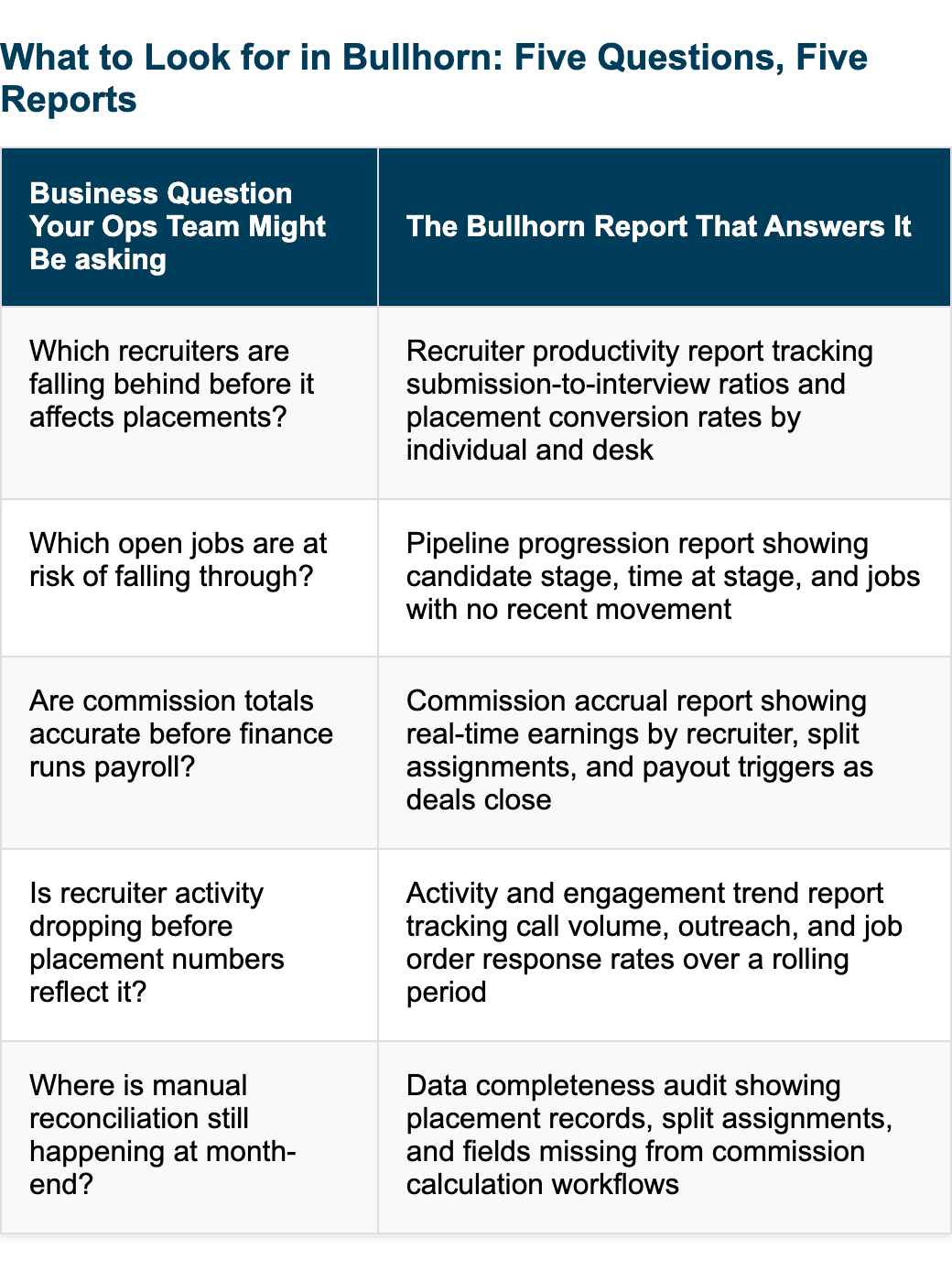
The goal is not to run every available report. It is to identify which data points answer the operational questions your team is already asking every week, and build a rhythm around reviewing them.
Recruiter Productivity Metrics
Submission-to-interview ratios, placement conversion rates, and time-to-fill by recruiter and job type tell you where performance is strong, where it is stalling, and whether workload distribution is creating bottlenecks. These are not vanity metrics. They are the difference between catching a performance issue in week two and discovering it at quarter-end when the damage is already done.
Pipeline Progression Reports
Where candidates are sitting across active jobs, and how long they have been at each stage, surfaces jobs at risk before they fall through rather than after a client follows up. This is the report most ops teams wish they had been running when a placement falls through unexpectedly. It is usually already available inside Bullhorn, just not configured as a standing view.
Commission Accrual and Payout Tracking
If you have Bullhorn-native commissions configured, real-time accrual reporting gives your recruiters visibility into their earnings as deals close and gives your finance team verified totals at month-end without manual reconciliation. This is where analytics and commission accuracy meet directly.
If your firm is still reconciling commissions in spreadsheets at close, you are likely sitting on Bullhorn reporting capabilities you never activated.
Across industries, nearly 29 percent of SaaS software spend goes underutilized or wasted, with teams defaulting to familiar tools even when more capable ones are already in place.2 Commission reporting is one of the clearest examples of that pattern in staffing operations.
Activity and Engagement Trends
Call volume, candidate outreach, and job order response rates over time help identify whether a recruiter’s placement numbers are declining because of pipeline quality or because activity dropped two months ago and no one caught it.
The distinction matters because the response is completely different. One is a coaching conversation. The other is a sourcing or market problem. Without the data, both look the same from the outside.
Stop Working Around the System You Already Own
Bullhorn analytics is only as useful as the reports built around it. If your ops team is making decisions in spreadsheets while Bullhorn runs in the background, the gap is usually in configuration, not capability.
Newbury Partners helps staffing firms identify which reports are worth building, connect them to commission and performance workflows, and create a Bullhorn analytics reporting rhythm that ops teams actually use. Contact us to find out what your current Bullhorn setup is leaving on the table.
References
1. Torres, Roberto. “Drain of App Switching: Why Employees Lose 5 Hours per Week.” HR Dive, 23 June 2021, www.hrdive.com/news/app-switching-enterprise-productivity-software-qatalog/602281/.
2. “Nearly One-Third of SaaS Spend Goes to Waste, Survey Says.” CIO Dive, 14 Oct. 2021, www.ciodive.com/news/saas-spend-control-enterprise-flexera/608257/.