

If you are reading this, you probably already know manual commission calculations hold many firms back. But here is where most staffing leaders hit a wall: commissions maturity is not one-size-fits-all, and solutions range from native ATS add-ons to $50K+ custom engines to managed analytics platforms.
Firms with simple structures waste money on over-engineered solutions. Firms with complex logic buy cheap tools and outgrow them within months. While 60% of IT implementations stay on budget, the 20% that don’t experience an average cost overrun of 450%.1
That is where a maturity model helps. By mapping your operations against four defined stages, you can identify which commission solution delivers ROI without overspending or creating future bottlenecks.
Why does your commissions maturity stage matter?
Your commissions maturity stage determines whether you need a $5K implementation or a $50K custom build. Getting this wrong means either overpaying for enterprise capabilities you will never use, or buying tools that fail within months as your complexity grows.
Over-investing wastes budget on features you will never use. A firm with straightforward commission splits does not need weighted attribution engines or predictive analytics. Under-investing creates operational bottlenecks. Trying to manage complex multi-variable commission logic in spreadsheets at scale leads to calculation errors, recruiter disputes, and finance team burnout.
The financial stakes are significant. Firms that implement the right-fit commission automation achieve $320K+ in middle office cost reductions. But choosing poorly means you either fail to capture those savings or spend unnecessarily on over-engineered solutions.
SoSo where does your firm fall on the commissions maturity spectrum?
What are the stages of commissions maturity?
Commission maturity progresses through four stages: Manual/Spreadsheet, Basic Automation, Advanced Logic, and Analytics-Driven. Each stage represents increasing complexity in how you calculate, track, and report on commissions.
Stage 1: Manual/Spreadsheet Chaos
- Commission structure: Flat rates or simple tiers
- Pain points: Excel errors, manual entry, frequent disputes
- Typical team size: Under 20 recruiters
Stage 2: Basic Automation (ATS-Native)
- Commission structure: Straightforward splits, universal percentages
- Solution: Built into existing ATS like Bullhorn Canvas
- Benefits: Real-time calculations, eliminates manual entry
- Timeline: 1-3 weeks to implement
- Typical team size: 20-100 recruiters
Stage 3: Advanced Logic (Bespoke Engines)
- Commission structure: Weighted attribution, multi-variable calculations, performance multipliers
- Solution: Custom-built systems for complex rules
- Benefits: Unlimited flexibility, owned internally
- Requirement: Internal IT or dev team
- Typical team size: 100+ recruiters or complex structures regardless of size
Stage 4: Analytics-Driven (BI Portal)
- Commission structure: Any complexity level plus predictive forecasting
- Solution: Hosted analytics platform with commission module
- Benefits: Real-time dashboards, strategic insights, no internal IT required
- Model: Vendor hosts infrastructure, you consume insights
- Sweet spot: $25M-$125M revenue firms
Understanding where you fall on this spectrum reveals which warning signs indicate it is time to move up a stage.
How do you know when to move to the next stage?
Your commissions maturity approach is holding you back when it consumes more than 10 hours per week in manual work, generates frequent disputes, or requires constant workarounds. The specific triggers vary by firm, but certain warning signs indicate it is time to level up.
Common warning signs you have outgrown your current approach:
- Finance or operations teams spend 10+ hours weekly on manual commission calculations
- Frequent calculation errors lead to recruiter disputes and eroded trust
- Commission rules require external spreadsheets or manual adjustments despite having automation
- Your ATS cannot accommodate multi-variable commission logic without workarounds
- Recruiters lack real-time visibility into their earnings and progress toward goals
- Leadership requests predictive forecasting or performance benchmarking that your current system cannot provide
- Manual overrides have become routine rather than exceptional
- You are managing commission calculations across multiple entities or subsidiaries with different rules
Firms that move from manual to automated commission systems save 6-10 hours per week per recruiter. Multiply that across your team to calculate the opportunity cost of staying in your current stage.
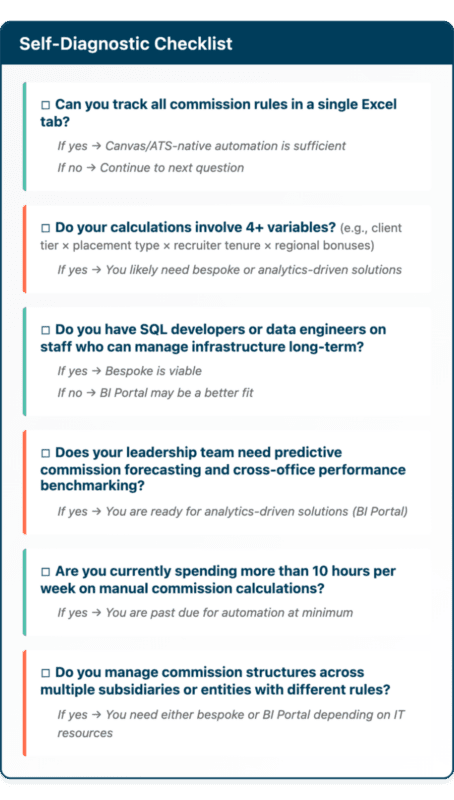
Use this diagnostic checklist to identify which maturity stage matches your current operations and which solution tier you need:
What solution fits your maturity stage?
Match your solution to your stage: Canvas for straightforward commission plans, bespoke engines for complex multi-variable logic, and BI Portal for firms who need analytics without managing infrastructure. The right solution depends on where you are today and where your complexity is headed.
Canvas/ATS-Native Automation
Best for:
- Universal commission rates or simple splits
- Straightforward tiered structures
- Teams under 100 recruiters
What it solves: Manual entry errors, lack of real-time visibility, calculation disputes
Key advantage: Works within your existing Bullhorn environment
Timeline: 1-3 weeks implementation
Bespoke Commission Engines
Best for:
- Weighted attribution across multiple contributors
- Complex multi-variable formulas
- Multiple entity structures or subsidiaries
What it solves: Commission logic too complex for ATS capabilities
Key advantage: Unlimited flexibility, you own the infrastructure
Requirement: Internal IT team to manage long-term
BI Portal with Commission Module
Best for:
- Strategic analytics needs beyond just calculations
- $25M-$125M revenue firms
- Organizations without data engineering resources
What it solves: Need for predictive insights, lack of internal IT infrastructure
Key advantage: Newbury hosts everything, you consume dashboards
Model: Subscription-based managed service
Newbury Partners Can Help Find Your Commission Solution Match
Not sure which commissions solution fits your firm’s commissions maturity level? Newbury Partners offers three clearly defined options matched to your commissions maturity level: Bullhorn-based automation for fast wins, bespoke engines for complex logic, and BI Portal for analytics-driven visibility. Schedule a commissions model maturity assessment to find your best path forward.
Reference
1. “Why So Many IT Projects Go So Horribly Wrong.” The Economist, 8 May 2025, www.economist.com/business/2025/05/08/why-so-many-it-projects-go-so-horribly-wrong.