

This 2026, your technology stack itself could become a staffing tech compliance liability. Here’s why:
AI hiring tools now require bias audits. Candidate data storage triggers disclosure requirements. Your vendor’s location determines whether you’re violating national security rules. Most staffing firms upgrade their ATS, CRM, and automation tools without realizing each one creates new compliance obligations.
The problem? Compliance violations don’t wait for your operations team to catch up. When your AI screening tool lacks required documentation or your systems can’t produce access logs during an investigation, penalties start accumulating immediately often across multiple jurisdictions.
This checklist helps you assess where your staffing tech creates compliance gaps before enforcement actions force expensive remediation.
Why Staffing Tech Compliance Is Different from Operational Compliance
Your operations team already knows how to handle worker classification and wage compliance. What they don’t know is that your technology stack just became a regulated compliance category with its own penalties.
The systems you use to screen candidates, store data, and manage workflows now trigger specific audit, disclosure, and documentation requirements that didn’t exist three years ago. Your AI tools need bias audits. Your vendors’ data storage location matters for national security compliance. Your ATS must produce access logs on demand.
Here’s the gap: most staffing firms upgrade to AI screening, automated assessments, and cloud-based systems without realizing each tool creates new compliance obligations. When your vendor experiences a security failure or violates regulations, you’re liable even if your operational compliance is perfect.
The compliance risk isn’t in your back-office operations. It’s in whether your technology can prove it’s compliant when regulators come asking.
Five Staffing Tech Compliance Areas to Audit Before 2026
These areas represent where staffing technology creates the most significant compliance exposure in 2026.
AI and Automated Decision Tools
57 percent of companies already use AI in hiring, and 74 percent report it improved hire quality but over half expressed concerns about AI screening out qualified candidates or introducing bias.1 Those concerns are now regulatory requirements.
For instance, California’s regulations define automated decision-making technology as any system that processes personal information to replace or substantially replace human decision-making in hiring, promotion, discipline, scheduling, or termination.2 This includes resume screening tools, candidate ranking algorithms, and performance analytics.
You need bias audits documenting algorithmic fairness, candidate notifications about AI use before screening, risk assessments weighing privacy risks against benefits, and third-party vendor oversight. Outsourcing to a vendor doesn’t eliminate liability.
These aren’t optional recommendations but enforced requirements with real financial consequences. NYC penalties start at $500 per violation, with each day counting separately. California’s notice requirements take effect January 1, 2027, giving you less than a year to implement compliant notification systems across your recruitment platforms.3
Candidate Data Collection and Storage
Your ATS collects data, but can you document what you’re collecting, how long you’re retaining it, where it’s stored, and who can access it?
The DOJ’s cross-border data rule, effective April 8, 2025, restricts personal data flows to countries of concern including China, Russia, Iran, North Korea, Cuba, and Venezuela.4 If your ATS vendor or background check provider stores data in these locations, you’re in violation.
You need CPRA disclosure at point of collection, automated data retention that doesn’t rely on manual deletion, access logging showing who viewed candidate PII and when, and vendor location verification with documented data residency. California businesses must ensure full compliance by January 1, 2026.
Third-Party Vendor Risk and Data Processing Agreements
Every tool that touches candidate or employee data creates potential liability; your ATS, VMS, background check providers, assessment platforms, payroll integrations, and productivity monitoring software.
Research shows 20% of organizations experienced third-party data breaches with SaaS providers,5 and California explicitly states that outsourcing automated decision-making doesn’t insulate you from liability.6 When your vendor fails, you’re responsible.
You need comprehensive vendor inventory including sub-processors, data processing agreements with every vendor accessing PII, vendor security assessments, continuous monitoring of vendor compliance status, and contract clauses covering breach notification and audit rights.
Pay Transparency in Job Postings
Your ATS job posting templates, client portal displays, and automated job board distributions now trigger state-specific disclosure requirements.
California SB 642, effective January 1, 2026, requires “good faith estimate” rather than broad salary ranges. Compensation now includes bonuses, stock options, benefits, and travel reimbursement. Multi-state staffing adds complexity: postings must comply with the state where the role is located or where remote candidates can work from.
You need updated ATS templates by state, client portals configured to require pay range input before posting, and audited automated job distribution across major boards, as California penalties range from $100 to $10,000 per violation.7
Audit Trails and System Logs
Can you prove who accessed what data, when, and why? CPRA requires records retention for four-plus years. EEOC discrimination investigations demand access logs. Data breach notifications require timeline documentation.
Your compliance requirements: enable system logging in ATS, CRM, and payroll systems; automate log retention rather than relying on manual exports; document admin access privileges; and implement continuous monitoring for anomalous access patterns.
Research shows this reduces risk identification by 50%.8 If you can’t produce logs showing who accessed a candidate’s data during an investigation, you’ve already failed compliance.
Your 2026 Staffing Tech Compliance Checklist
Use this assessment to identify staffing tech compliance gaps requiring immediate attention.
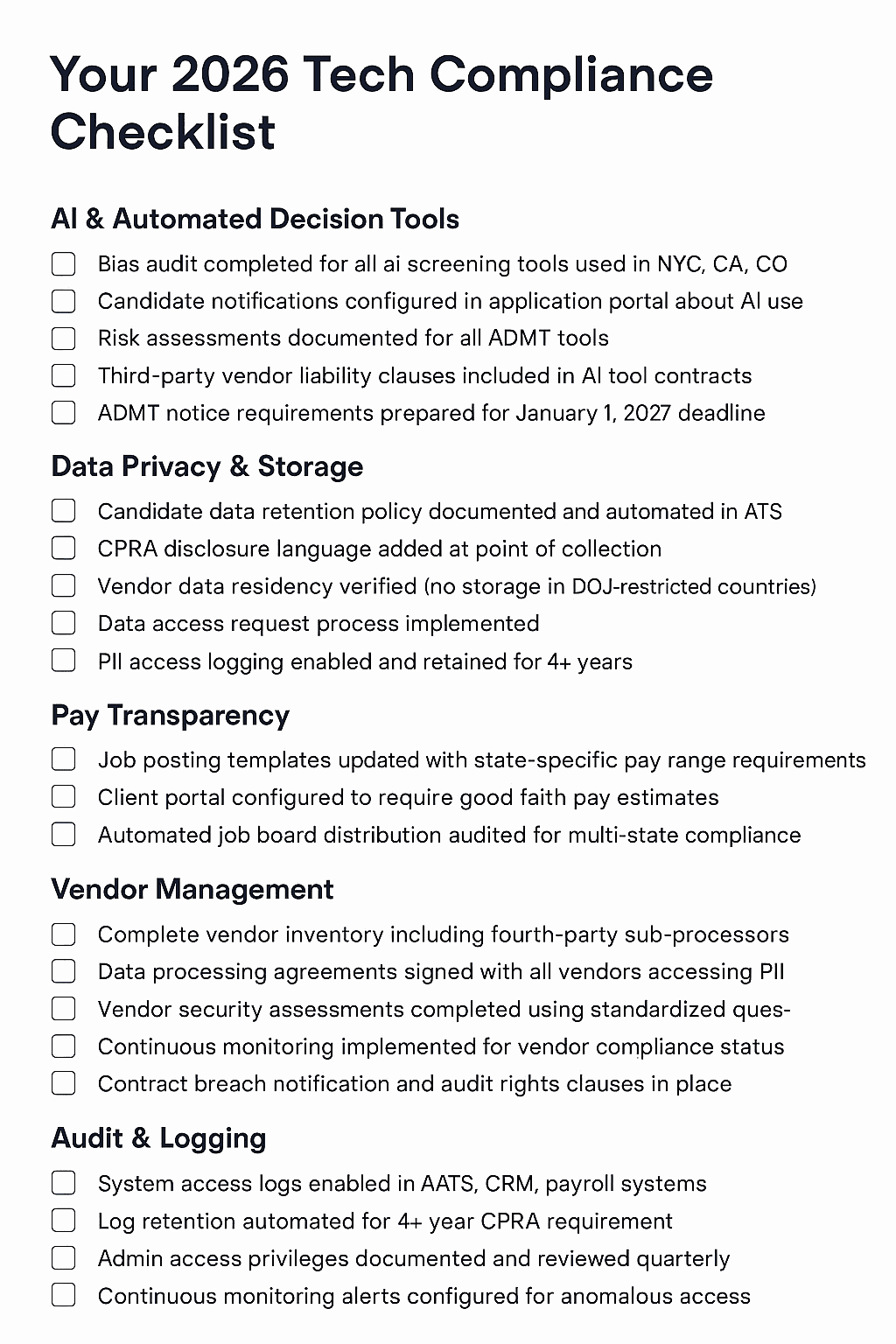
Assess Your Risk
- 20+ checked: Strong tech compliance posture, focus on continuous improvement
- 12-19 checked: Moderate gaps requiring Q1 2026 attention
- Under 12 checked: Significant exposure requiring immediate remediation before January 1
Don’t Let Your Tech Stack Become a Compliance Liability
Newbury Partners helps staffing firms audit their technology ecosystem for staffing tech compliance gaps before they trigger penalties. From AI tool assessments and data privacy protocols to vendor risk management and system logging, we ensure your tech investments meet 2026’s regulatory requirements.
As Bullhorn’s #1 System Integration Partner with expertise across the staffing tech landscape, we build staffing tech compliance readiness into every implementation and integration. Contact us today to assess your tech compliance posture.
References
1. Crist, Carolyn. 1 in 3 Companies Say AI Will Run Their Hiring Process by 2026. 22 Aug. 2025, HR Dive, https://www.hrdive.com/news/ai-hiring-process/758384/.
2., 3., 6. Wang, Linda. CCPA Finalizes AI Regulations for Automated Decision-Making Technology. 11 Aug. 2025, CDF Labor Law, https://www.cdflaborlaw.com/blog/california-finalizes-ai-regulations-for-automated-decision-making-technology.
4. Chestler, Alisa, and Vivien F. Peaden. DOJ Cross-Border Data Transfers Rule: Key Implications for Companies Operating in the US. Infosecurity Magazine, 6 June 2025, https://www.infosecurity-magazine.com/opinions/doj-data-transfers-rule/.
5., 6., 8. Saroff, Daniel. Third-Party Risk Management: Don’t Get Fired Due to Someone Else’s Failure. CIO, 5 Aug. 2025, https://www.cio.com/article/4034370/third-party-risk-management-dont-get-fired-due-to-someone-elses-failure.html.
6. Zaller, Anthony. “Friday’s Five: Governor Newsom Signs SB 642 — Major Updates to California’s Pay Transparency and Equal Pay Laws.” California Employment Law Report, 17 Oct. 2025, https://www.californiaemploymentlawreport.com/2025/10/fridays-five-governor-newsom-signs-sb-642-major-updates-to-californias-pay-transparency-and-equal-pay-laws/.


