

Say your team just went live with a new ATS. Onboarding wrapped up last month, everyone has login credentials, and your vendor sent over a “successful implementation” email. But how do you know your recruiters are actually using the new features, or if they revert to their old spreadsheets? Is your tech adoption saving time, or just adding more steps? And how do you even measure whether your investment in your tech adoption is paying off?
Most staffing firms treat implementation as the finish line when it’s really just the starting point. Without clear metrics to track adoption and impact, you’re left guessing. The right KPIs tell you whether your tech is being adopted, where friction points exist, and if you’re actually getting value or just paying for potential.
Why Tracking Tech Adoption KPIs Matters
Implementation doesn’t equal adoption, and adoption doesn’t guarantee results. More than 70 percent of recently implemented ERP initiatives fail to fully meet their original business case goals, with as many as 25 percent failing catastrophically.1 For staffing firms investing heavily in new systems whether it’s an ATS, CRM, or VMS the stakes are similar.
Without measurement, you’re operating on assumptions. Here’s why KPIs are critical:
You Can’t Fix What You Can’t See
If your new system isn’t delivering the productivity gains you expected, you need data to pinpoint why. Are recruiters struggling with a clunky interface? Is a key integration not working as promised? KPIs surface these friction points before they become permanent workarounds.
Tech Adoption Gaps Cost More Than You Think
A system that’s only partially adopted is still a full-price investment. When half your team uses the new ATS while the other half sticks to spreadsheets, you’re paying for duplicate effort and inconsistent data, not efficiency.
Fast-Growth Firms Measure Tech Adoption Differently
The staffing agencies experiencing the strongest growth aren’t just buying more technology; they’re being strategic about what they measure. Sixty-two percent of fast-growth agencies plan to purchase new software solutions in 2026, with many allocating 21 to 50 percent of their total budget to technology.2 The difference between smart investment and wasted spend is tracking the metrics that matter.
Top 5 Metrics for Tech Adoption in 2026
Tracking the right KPIs transforms tech adoption from a hopeful rollout into a measurable business outcome. Here are the top tech adoption metrics to track:
1. Active User Rate
This measures the percentage of your team actually logging in and using the system regularly not just once during training, but consistently over time. A system with low active user rates signals adoption failure before it becomes a sunk cost. If only 40 percent of your recruiters are using the new ATS three months post-launch, you’re not getting the efficiency gains you paid for.
Aim for 80 percent or higher active usage within 90 days of go-live. Anything below 60 percent suggests either poor training, a tool that doesn’t fit your workflow, or resistance that needs to be addressed before it becomes permanent.
2. Time-to-Productivity
This tracks how long it takes for a new user whether a new hire or an existing team member learning a new system to reach full productivity. Long ramp times mean your investment isn’t paying off quickly enough. If recruiters take two months to feel comfortable in your new CRM, that’s two months of reduced output and potential placement delays.
For most staffing systems, users should reach baseline productivity within 2–3 weeks and full proficiency within 30–45 days. If it’s taking longer, your training approach or the system’s usability may need adjustment.
3. Process Efficiency Gains
This measures whether the new system is actually reducing the time or effort required to complete key workflows; submitting candidates, updating job orders, generating reports, or managing client communications. Technology should make work faster and easier, not add steps. If your team is still spending the same amount of time on candidate submissions after implementing a new ATS, the system isn’t delivering on its promise.
Look for measurable time savings in high-frequency tasks. If candidate submission used to take 10 minutes and now takes 6, that’s a 40 percent efficiency gain that compounds across hundreds of placements.
4. Data Quality and Completeness
This tracks whether your system is producing accurate, complete, and consistent data; candidate records, job order details, client information, and placement history. Dirty data undermines everything else. If recruiters are entering incomplete profiles, skipping required fields, or duplicating records, your reporting becomes unreliable, and your team wastes time cleaning up mistakes.
Track metrics like the percentage of candidate profiles with complete contact information, the rate of duplicate records, and how often required fields are left blank. High-performing teams maintain 90 percent or better data completeness and actively audit for duplicates.
5. ROI and Cost-Per-Placement Impact
This measures whether your technology investment is improving your bottom line either by reducing costs, increasing placements, or both. If your new system costs $50,000 annually but doesn’t reduce cost-per-placement or increase placement volume, it’s not delivering ROI. Tracking financial impact helps you make informed decisions about renewals, upgrades, or whether to cut your losses.
Calculate your cost-per-placement before and after implementation. If the new system reduces administrative overhead or increases recruiter capacity, you should see a measurable decrease in cost-per-placement within 6–12 months.
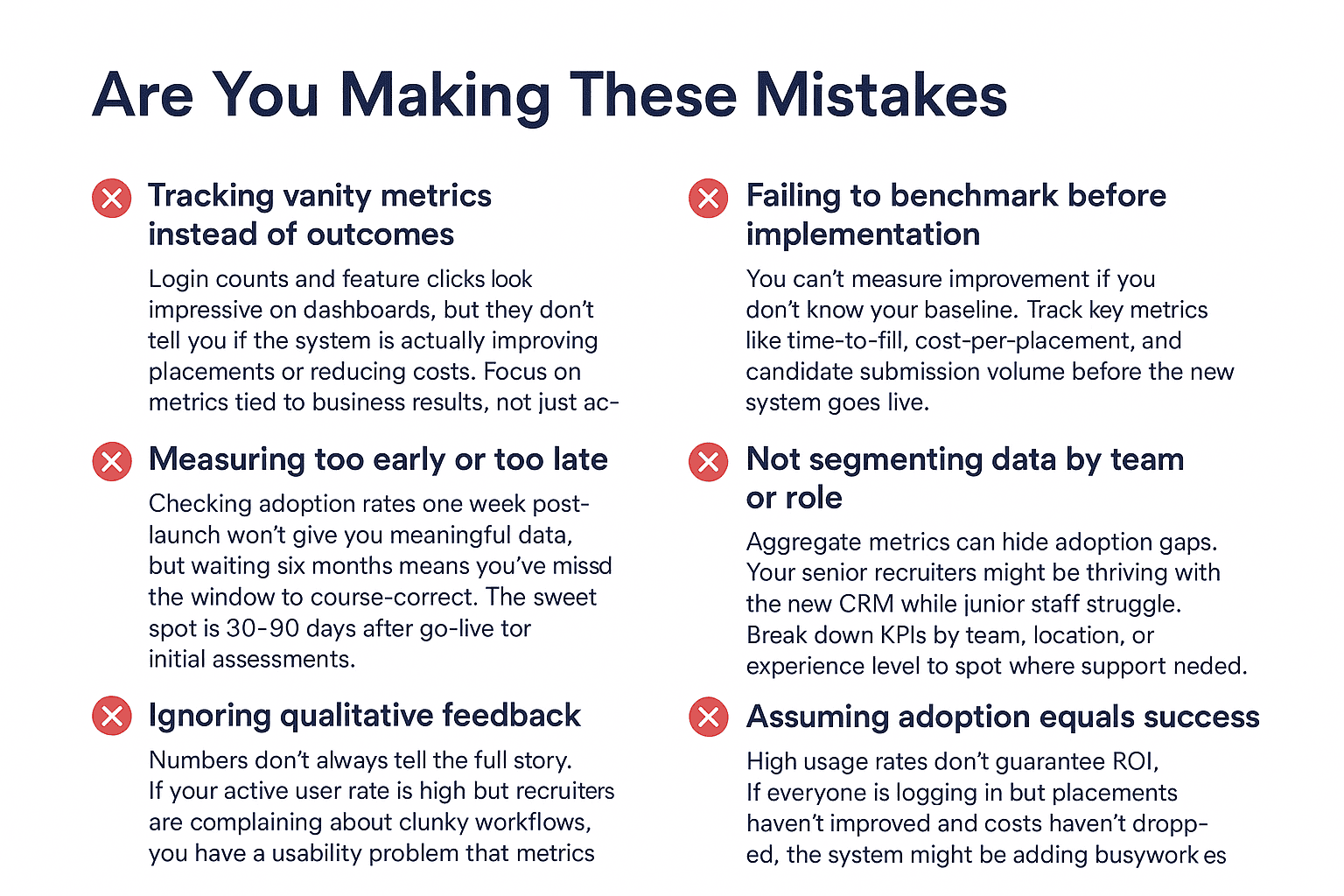
Common Tech Adoption Mistakes and Blind Spots to Avoid
Even firms that track KPIs can fall into common traps that skew their data or lead to poor decisions. Watch out for these tech adoption pitfalls:
Newbury Partners Can Help You Measure What Actually Matters
Tracking the right KPIs is the difference between a tech investment that transforms your operations and one that drains your budget without delivering results. Newbury Partners helps staffing firms implement systems that work and measure the metrics that prove it.
From Bullhorn optimization to full tech stack integration, we ensure your technology delivers measurable ROI, not just promises. Contact us today to build an adoption strategy that’s backed by data, not hope.
References
1. Enterprise Resource Planning to Optimize Operations. Gartner, https://www.gartner.com/en/information-technology/topics/enterprise-resource-planning.
2. Staffing Tech Budgets Are Shifting: Where Smart Agencies Are Spending in 2025. Staffing Hub, 10 July 2025, https://staffinghub.com/state-of-staffing/staffing-tech-budgets-are-shifting-where-smart-agencies-are-spending-in-2025/.