

The decision to automate staffing commissions inside a live operation feels riskier than it is, and that gap between perception and reality is what keeps firms on manual processes longer than they should stay. Does automating commissions feel like a risk you cannot afford to take on a live operation? That hesitation is more common than most leaders admit, and it may be the reason some firms stay on manual processes longer than they should.
The fear is not that automation will fail. The fear is that switching mid-operation will create a gap where payroll stalls, recruiters lose visibility, and finance scrambles to reconcile two systems at once. That picture is what keeps firms on spreadsheets even when they know the manual process is unsustainable.
But the transition window most leaders imagine does not match what commission automation inside Bullhorn actually requires or how go-live is sequenced when done right.
What Most Firms Get Wrong About Commission Automation Risk
Most of what makes firms hesitant to automate staffing commissions has more to do with how the transition is imagined than how it actually runs.
The Fear Is About the Transition Window, Not the Destination
Firms picture a gap where the old process is gone, and the new one is not yet trusted. That is where fear lives, not in the technology itself. When asked why they remain on manual processes, finance leaders cite lack of time to onboard new systems (31 percent) and lack of time to manage implementation (36 percent) as top barriers.1
The concern is not whether automation will work once it is live. The concern is whether the firm can afford the disruption of getting there. But that disruption exists primarily in how firms imagine the transition, not in how commission automation is actually implemented inside Bullhorn.
Recruiters Are Not Resistant to Automation; They Are Resistant to Surprises
The assumption that recruiters will push back usually comes from past rollouts where tools changed without warning. Commission automation inside Bullhorn does not ask recruiters to learn a new platform. It surfaces their numbers inside the system they already use daily.
What recruiters resist is being left in the dark about how their payouts are calculated. Automation that increases visibility eliminates that problem rather than creating it.
The Comp Plan Does Not Need to Change for Automation to Work
A common assumption is that automating commissions means redesigning how compensation is structured. For straightforward structures, the existing comp plan maps directly into Bullhorn. Automation executes the rules already in place; it does not replace them.
If your commission structure fits in a single spreadsheet tab, the rules can be configured into Bullhorn without requiring finance to rethink how payouts are designed.
Implementation Runs Alongside Your Operation, Not Instead of It
Here is what actually happens during the three weeks most firms spend worrying about disruption.
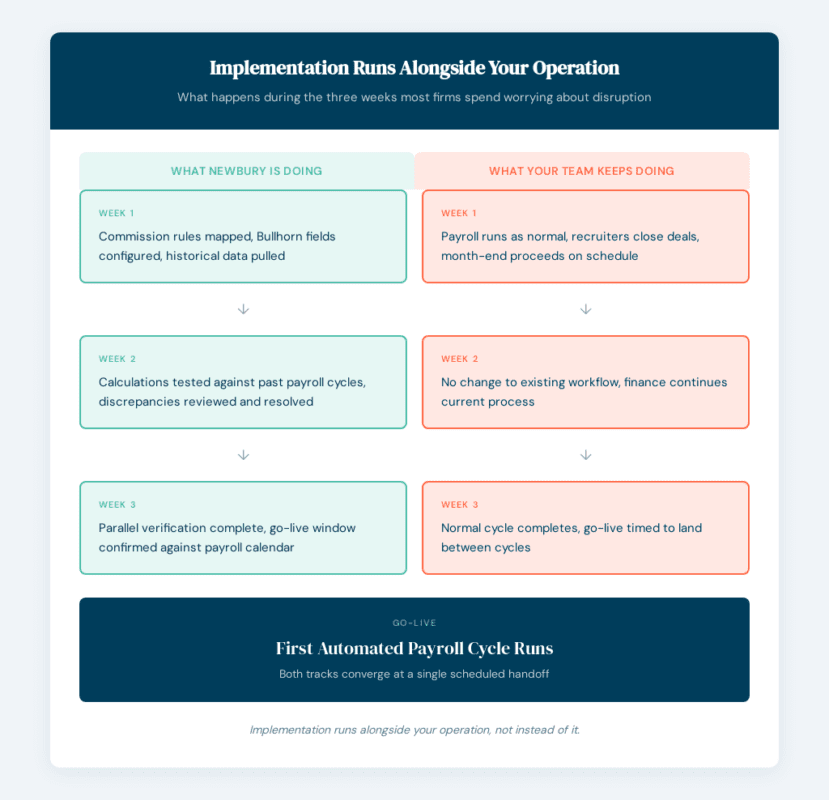
What a Bullhorn Commissions Go-Live Looks Like When Done Right
Implementation is sequenced specifically to avoid the disruption firms fear, and for straightforward commission structures, the timeline is shorter than the deliberation usually is.
Configuration and Testing Run Parallel to Your Existing Process
Nothing in your current workflow is removed until calculations have been verified against real historical data. Your payroll cycle keeps running while the new configuration is tested alongside it. Commission rules are mapped into Bullhorn, calculations are run against past payout cycles, and discrepancies are resolved before anything goes live.
There is no window where your operation is exposed. The parallel approach means finance can verify that automated outputs match manual results before the system takes over.
Go-Live Is Timed Around Your Payroll Calendar, Not Against It
The first live cycle is chosen deliberately, not dropped in mid-close. For most firms with straightforward structures, setup fits between payroll cycles.
The transition is a scheduled handoff, not an interruption. Go-live happens when your current cycle completes, so there is no overlap where finance is managing two processes at once. The timing is coordinated with your payroll calendar to minimize friction, not create it.
Read More: How Finance Teams Benefit from Automated Recruiter Commissions
The First Automated Close Is Faster Than the Last Manual One
Automated payroll processing cuts errors by up to 50 percent and reduces processing time by 25 percent.2 Finance is no longer manually bridging placement data to payout totals. Reconciliation work that used to take days compresses into hours because the system maintains consistency between placements and payouts automatically. The first month-end close after go-live runs as a confirmation, not a reconciliation. Finance verifies outputs rather than calculating them from scratch.
The Transition Window You Fear Is Shorter Than You Think
The firms that stay on spreadsheets longest are often the ones whose commission structures are simple enough to automate in weeks. If your current structure fits a single spreadsheet tab, the transition window you are worried about is likely shorter than the deliberation.
Newbury Partners scopes implementation around your payroll calendar, so there is no gap between what you have and what you are moving toward. Contact us to find out where you stand.
References
1. “Payroll Compliance Challenges for Small Businesses, Survey Reveals.” International Accounting Bulletin, 6 Aug. 2025, www.internationalaccountingbulletin.com/news/sme-payroll-compliance-challenges/.
2. Martens, Karolien. “Payroll in Transition: Trends in Automation, Accuracy, and Remote Readiness.” Deloitte Belgium, 29 Sept. 2025, www.deloitte.com/be/en/services/tax/blogs/tax-legal-pulse/011-payroll-in-transition-trends-automation-accuracy-remote-readiness.html.