

Your BI dashboard is working. Placement volumes, revenue by division, recruiter performance; the data is there. What it cannot tell you is which recruiters are approaching capacity limits next month, where role demand is likely to spike, or which revenue gaps are forming before they become urgent. Having good data and planning with it are two different things.
AI workforce planning for staffing addresses exactly that gap. It does not replace the reporting infrastructure you have already built. It applies your historical data forward, turning what happened last quarter into a signal for what your team will need next quarter. If you are managing multiple divisions, shifting demand, and tight hiring windows, that distinction changes how you run the business.
Why Having the Data Is Not the Same as AI Workforce Planning for Staffing
Dashboards confirm what happened, not what is coming.
Reporting tells you a capacity gap existed after it affected a billing cycle. It tells you a recruiter hit a wall after placements slowed. By the time those signals appear in a monthly report, the revenue impact is already in motion.
The lag between a problem forming and appearing in a report is where revenue leaks.
By the time a capacity issue or demand shift surfaces in monthly reporting, there is already a gap between what you think is happening and what is actually happening on the ground. That lag is not a reporting failure; it is a structural limitation of backward-looking data.
Without a forward-looking layer, decisions default to gut feel.
When predictive signals are absent, workforce decisions; when to hire, how to redistribute load, which client commitments are at risk, get made on experience and instinct. That works in stable conditions. It breaks down when demand shifts faster than you can track manually across divisions, roles, or verticals.
The result is not always a visible crisis. That pattern of near-misses is exactly what AI workforce planning for staffing is designed to interrupt before it compounds across divisions.
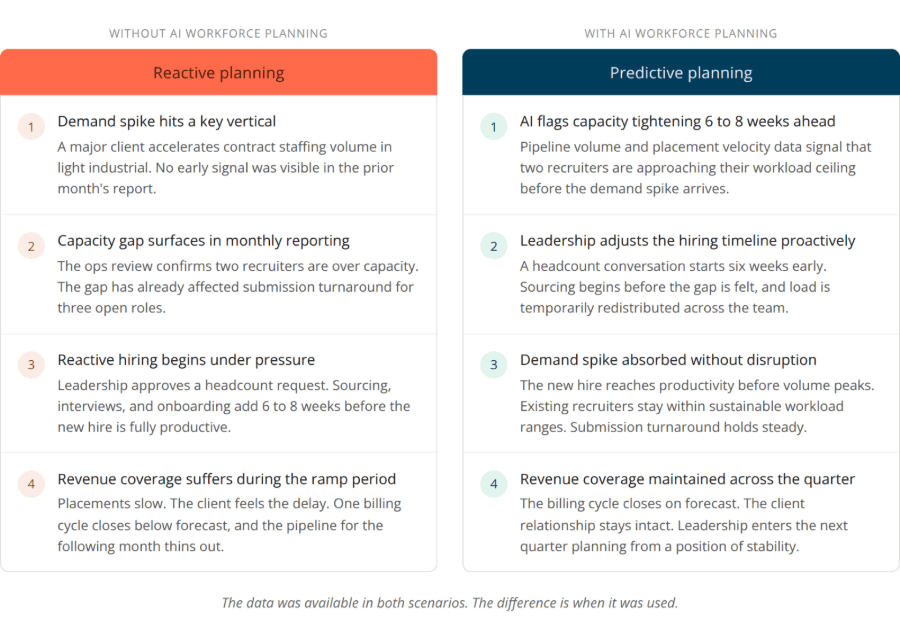
What AI Workforce Planning for Staffing Actually Changes
AI workforce planning does not replace the BI data you already have. It applies that data forward instead of backward.
Recruiter capacity gaps become visible before they affect output.
AI maps current workload against placement velocity and pipeline volume to flag where capacity is tightening ahead of time. You can redistribute load, adjust timelines, or begin a hiring conversation before a recruiter hits a wall and a client relationship feels it.
That kind of early visibility changes the nature of the decision you are making. Instead of responding to a problem that has already affected output, you are making a proactive staffing call with enough runway to execute it well.
Demand forecasting replaces assumption with signal.
AI workforce planning for staffing replaces demand assumption with signal by combining historical placement patterns with current pipeline data to model where role demand is likely to shift. AI-driven forecasting reduces errors by 20 to 50 percent compared to spreadsheet-based methods, and reduces lost revenue exposure by up to 65 percent.1
That accuracy gap matters most when you are making hiring or resourcing decisions with a 6 to 8 week lead time. A forecast that is wrong by 30 percent in either direction does not just affect one month. It ripples into the next quarter.
Scenario planning lets leadership stress-test before committing.
What happens to revenue coverage if two senior recruiters reach capacity at the same time? What does a volume increase in one division do to the rest of your team? Predictive modeling lets you run those questions on existing data before they become real operational problems.
The value is not that the model predicts the future with certainty. That is the stress-testing capability AI workforce planning for staffing makes available before decisions are locked in.
Leadership conversations shift from explaining gaps to preventing them.
AI workforce planning for staffing shifts the monthly ops conversation from diagnosing why last month fell short to deciding what to do about next month before it arrives. That shift from retrospective to operational is where the real staffing workforce forecasting value sits.
Over time, that change in cadence compounds. Teams that plan forward consistently make fewer reactive hiring decisions, absorb demand shifts with less disruption, and build the kind of operational predictability that supports growth without adding proportional overhead.
Your Data Is Already There, Now Put It to Work
Your BI data is already tracking placement volumes, recruiter performance, and revenue by division. What it cannot do on its own is tell you what is coming next quarter before it affects this one.
Navigator, Newbury Partners’ quarterly advisory engagement, helps staffing leaders connect AI workforce planning for staffing insights to real capacity and hiring decisions using the Bullhorn data already in place.
Each engagement cycle is hands-on, focused on your firm’s specific structure, and designed to move forecasting conversations from reactive to operational. If you are ready to plan forward instead of reporting backward, schedule a conversation with us today.
Reference
1. Amar, Jorge, et al. “AI-Driven Operations Forecasting in Data-Light Environments.” McKinsey & Company, 15 Feb. 2022, www.mckinsey.com/capabilities/operations/our-insights/ai-driven-operations-forecasting-in-data-light-environments.